
Views: 0 Author: Site Editor Publish Time: 2026-08-08 Origin: Site


Foam acronyms like XPE, EPE, and EVA dominate the play mat market today. This alphabet soup often leaves parents and facility managers confused. Evaluating safety and durability becomes extremely difficult without a background in material science. Choosing the wrong material creates serious problems. Inferior mats degrade rapidly, leading to peeling surfaces and dangerous flaking. They also present hygiene risks and expose children to volatile organic compounds. You need a safe, reliable surface for daily activities. Both XPE and EPE originate from polyethylene base materials. However, their specific manufacturing processes dictate vastly different outcomes. We will explore how these structural differences impact longevity, daily performance, and overall safety. You will learn exactly how to identify high-quality foam and why investing in the right material protects your children.
Structure: XPE (Cross-linked Polyethylene) features a tightly bonded cellular structure, offering superior durability and zero flaking compared to EPE (Expanded Polyethylene).
Safety: High-quality XPE meets strict global compliance standards (ASTM, EN71) and is naturally free of BPA, Phthalates, and formamide.
Use Case: EPE is suitable for temporary, budget-conscious needs; an XPE baby mat is the industry standard for long-term, high-traffic daily use.
ROI: While XPE carries a higher upfront cost, its structural integrity lowers the total cost of ownership by eliminating the need for frequent replacement.
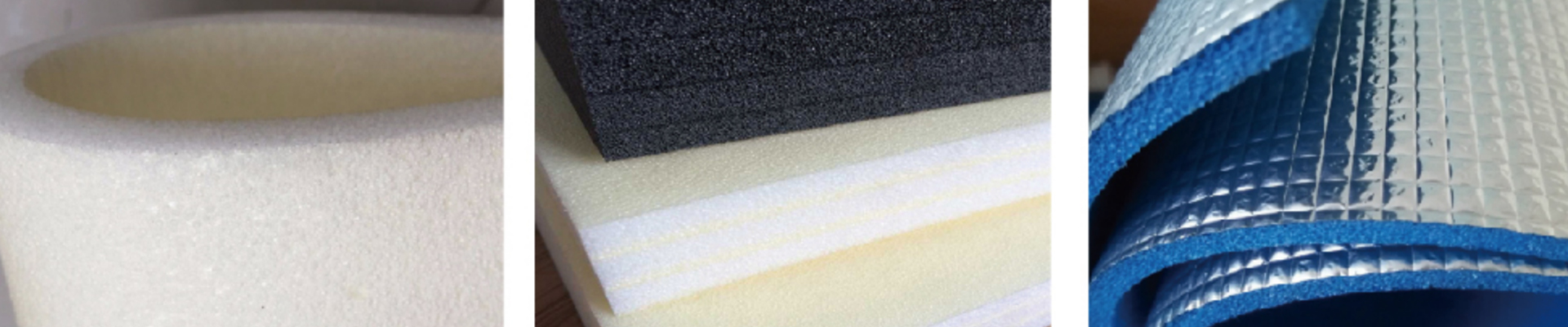
Manufacturers build both mats from a polyethylene base. The chemical treatment during production changes the final product entirely. We must examine the physical makeup of each foam to understand their performance.
EPE relies on a basic expansion process. Manufacturers inject a blowing agent into polyethylene resin. This expands the plastic into foam. However, the internal polymer chains remain completely separate. They never interlock. This creates a non-cross-linked cellular structure. The foam cells are relatively large and trap air loosely.
In real-world implementation, EPE behaves poorly under stress. The trapped air escapes quickly when you step on it. EPE lacks structural memory. Under prolonged pressure, the foam collapses permanently. You will often hear a distinct squeaking or crunching sound underfoot. The surface remains highly susceptible to punctures. A dropped toy or a pet claw can easily pierce the loose outer film.
XPE utilizes a highly advanced manufacturing technique. The process involves specialized heat treatment and cross-linking agents. This forces the individual polymer chains to bond chemically. They form a continuous, 3D molecular matrix. We call this a cross-linked structure.
This implementation results in a premium high-density material. The foam features a micro-cell structure. The cells are microscopic and tightly packed together. They trap air securely. When a child falls, the material compresses slightly and rebounds instantly. It possesses excellent structural memory. An XPE surface will not crunch or squeak. It feels firm, rubbery, and highly supportive.
Many consumers approach foam products with valid skepticism. Historically, cheap foam mats released strong chemical odors. These smells often indicate the presence of volatile organic compounds (VOCs). We must evaluate how each material handles chemical additives.
Some manufacturing methods require harsh chemical binders. Manufacturers use glues to laminate printed designs onto base foams. EPE mats frequently rely on this cheap lamination process. As the adhesive breaks down, it releases odors into your home. Cross-linking typically requires fewer harsh chemicals. The XPE manufacturing process utilizes thermal bonding instead of glue. Intense heat melts the layers directly together. This eliminates the need for toxic adhesives. It drastically reduces the risk of chemical off-gassing.
You must always verify third-party testing when shopping. Do not rely on vague marketing claims. A credible xpe baby mat should explicitly display global certifications. Look for CE, EN71, or ASTM compliance labels. These standards ensure the product passes rigorous safety tests. Laboratories check for heavy metals, phthalates, and formamide. If a vendor cannot produce these certificates, you should look elsewhere.
Surface degradation poses another serious risk. Inferior EPE mats present a known choking hazard. The top printed film often separates from the foam base over time. Toddlers can easily pick at these loose edges. The film then flakes off in small pieces. Babies often put these flakes in their mouths. XPE prevents this danger entirely. The thermal-bonding process fuses the layers permanently. The surface resists delamination completely.
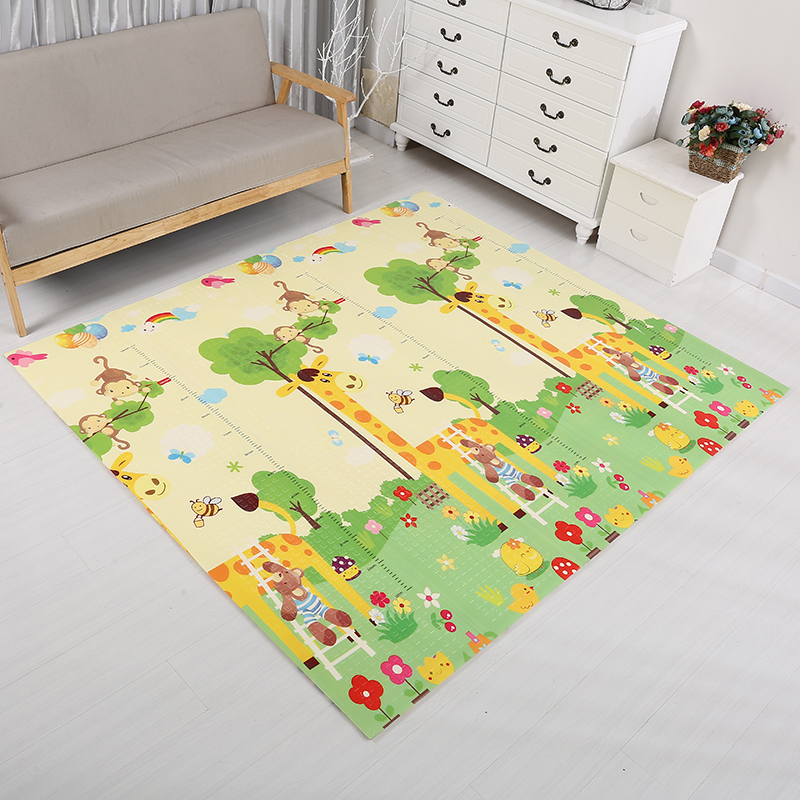
A play space must endure heavy daily traffic. Toddlers fall constantly as they learn to walk. The physical properties of your foam directly affect child safety and parental convenience.
Compression recovery rates vary wildly between materials. EPE bottoms out quickly upon impact. The large foam cells burst or flatten under sudden weight. A falling child will feel the hard floor right beneath the mat. XPE behaves differently. It features high shock absorption. The cross-linked micro-cells distribute impact energy laterally. The foam cushions the fall effectively. It protects knees and heads from hard impacts.
Material density directly impacts storage and usability. EPE lacks structural integrity. Manufacturers usually design EPE mats as foldable squares to compensate. The folding creases trap dirt endlessly. They also wear down quickly. XPE offers far better format versatility. Its robust structure allows manufacturers to produce seamless rolls. You can easily unroll a xpe rolling play mat across a large room. It resists permanent creasing. It lies flat immediately after storage.
Spills happen constantly in play areas. Both materials are technically water-resistant when new. However, EPE's larger cells weaken over time. Daily friction creates microscopic tears in the surface. Liquids seep into these micro-tears. Bacteria breed inside the damp foam. You cannot wash it out completely. XPE features a fully closed-cell surface. It remains impermeable throughout its lifespan. You can wipe messes away effortlessly. The material will never absorb fluids or harbor hidden bacteria.
Pricing often dictates consumer choices. However, evaluating foam mats based purely on the initial price tag leads to poor decisions. We must examine the actual functional lifespan of these materials.
The table below outlines the core differences in lifespan and value expectations.
Evaluation Metric | EPE Foam Mats | XPE Foam Mats |
|---|---|---|
Initial Purchase Price | Very low (Budget tier) | Moderate to High (Premium tier) |
Functional Lifespan | 3 to 6 months | 2 to 3 years |
Replacement Frequency | High (Tears and flakes easily) | Very Low (Maintains structure) |
Aesthetic Retention | Fades and peels quickly | Resists fading and peeling |
Many buyers fall into the EPE budget trap. EPE looks incredibly appealing at first glance. It costs significantly less upfront. You might find a large EPE mat for a fraction of a premium model. However, you must factor in the replacement frequency. EPE degrades rapidly under heavy daily use. The surface punctures easily. The edges begin to curl. The printed film starts peeling. Most active households replace EPE mats every three to six months. This short lifespan turns a cheap purchase into a recurring expense.
We evaluate XPE on a cost-per-year basis instead. The initial price tag runs noticeably higher. Yet, a quality XPE surface offers a functional lifespan of two to three years. It sustains its aesthetic quality beautifully. It resists punctures and remains supportive. You eliminate the hassle of constant replacements. Your investment stretches much further over the toddler years.
We must make a transparent assumption here. Not every situation demands heavy-duty performance. You might need a temporary travel mat. You might want something for a grandparent's house visited rarely. EPE suffices perfectly for these low-traffic scenarios. It provides adequate temporary padding. However, primary household use requires superior durability. For daily play spaces, XPE represents the absolute baseline for safety and value.
Choosing the right surface requires careful evaluation. You need a practical way to shortlist options. Use our framework to guide your next purchase.
Many parents buy solely based on cute patterns. They ignore the underlying material. This common mistake leads to early degradation. Use this checklist when evaluating products:
Check the density: Lift the mat if possible. A heavier mat indicates better cross-linking and tighter foam cells.
Inspect the edges: Look for heat-pressed borders. Avoid stitched fabric borders entirely. Stitches fray rapidly and trap allergens.
Verify ink safety: Confirm the manufacturer uses non-toxic, plant-based ink layers for their prints.
Look for: Explicit material disclosures. Brands should proudly state they use cross-linked polyethylene.
Avoid: "Bargain" mats lacking exact material labels. Unknown brands often sell cheap blends. They mix scrap plastics into basic EPE foam. This compromises both safety and performance.
Your next step requires active verification. Do not accept vague marketing terms like "eco-friendly foam." Check the exact material specifications before you checkout. Look for specific cross-linked terminology in B2C product descriptions. If you run a commercial space, request compliance certificates directly from the vendor. Active verification ensures you invest in a truly safe product.
The difference between XPE and EPE goes far beyond basic structure. The underlying manufacturing process dictates everything about the product. It determines safety levels, daily maintenance routines, and overall lifespan. EPE works for brief, temporary padding. However, XPE provides the structural integrity necessary for active children.
We strongly recommend prioritizing XPE for all primary play spaces. It guarantees superior compliance with global safety standards. It delivers reliable longevity under heavy use. You protect your children from dangerous off-gassing and choking hazards. Take action today by evaluating your current play surfaces. Browse certified XPE collections from reputable vendors, or request a material sample to feel the density difference yourself.
A: No foam mat is entirely scratch-proof. XPE features high-density micro-cells that resist everyday wear and tear beautifully. However, sharp objects can still puncture the surface. You should keep pet claws trimmed. Avoid dragging heavy furniture or sharp metal toys across the mat.
A: We recommend indoor use for maximum lifespan. You can use it outdoors temporarily on smooth grass. However, prolonged exposure to direct sunlight causes UV degradation. Rough outdoor dirt and concrete also create excessive friction. This friction will wear down the waterproof film prematurely.
A: Raw expanded polyethylene is technically non-toxic. The base plastic itself does not harm children. However, the chemical risks usually lie in the manufacturing assembly. Budget EPE mats rely on cheap glues and toxic films to bind the printed layers to the foam. These adhesives frequently off-gas dangerous compounds.