
Views: 0 Author: Site Editor Publish Time: 2026-07-21 Origin: Site


Choosing an XPE (cross-linked polyethylene) mat means you have already conquered the material safety hurdle. You can rest easy knowing it is free from BPA, phthalates, and VOCs. Now comes the practical challenge of integrating it into your home. Selecting the right dimensions often feels overwhelming. You need to balance developmental milestones, room constraints, and daily storage realities. A poor size choice can lead to tripping hazards or insufficient safe zones for a wobbly toddler. The ideal size relies on a matrix of room layout, format choices like rolling versus folding, and your child's motor development phase. We will break down exactly how to measure your space efficiently. You will learn how to evaluate your floor plan and choose a mat size perfectly tailored to your family's evolving daily routines.
Match Size to Motor Milestones: Tummy time requires minimal space, while crawling and cruising demand a larger, uninterrupted radius to prevent floor-impact injuries.
Factor in Format Constraints: An xpe rolling play mat offers a seamless surface for permanent setups, whereas foldable mats provide scalable sizing but introduce seams.
Calculate Clearance: Always leave a minimum 12-inch buffer between the mat edge and hard furniture to account for rolling momentum and trip hazards.
Thickness Dictates Footprint: Thicker mats (0.6”+) require more storage volume, impacting whether a large size is viable for smaller homes.
Your child’s physical abilities change rapidly during their first year. You must align your flooring coverage to match their specific mobility levels. A stationary newborn uses space entirely differently than an aggressive toddler. We categorize these sizing requirements into three distinct motor milestone phases.
Newborns and infants up to six months primarily build core strength. They stay exactly where you place them. Therefore, you do not need expansive square footage yet. Focus on targeted, high-quality support instead.
Ideal Size: Small to Medium (approx. 50" x 50").
Evaluation Criteria: You need sufficient space for the baby and one caregiver. Success here focuses on osteopath-aligned firm support for neck development. Small sizes fit easily into cozy nursery corners. They provide excellent shock absorption for an infant learning to lift their head. A massive mat is unnecessary and often creates unwanted clutter during these early months.
Once your baby begins to pivot, scoot, and crawl, their required safe zone expands dramatically. They discover momentum. They also experience sudden losses of balance while attempting to sit unassisted.
Ideal Size: Large (approx. 70" x 50" to 70" x 70").
Evaluation Criteria: You require an ample "roll-off" radius. Babies at this stage change direction quickly. They routinely tip over backwards or sideways. Undersized mats inevitably lead to frequent falls onto hard flooring. A large size ensures they stay protected even after taking a few consecutive rolls away from the center point.
Toddlers learning to stand will use couches, coffee tables, and bookshelves for leverage. They take uncoordinated, heavy steps. Their falls carry significantly more downward force.
Ideal Size: Extra-Large (approx. 79" x 70" or larger).
Evaluation Criteria: Maximum coverage becomes mandatory. Success is defined by creating a comprehensive safe zone for uncoordinated standing and high-impact falls. You want to cover as much exposed hardwood or tile as possible in their primary play area. This minimizes the risk of sudden head impacts against bare floors.
Developmental Stage | Recommended Dimensions | Primary Safety Focus |
|---|---|---|
Pre-Crawlers (0-6 Mo) | 50" x 50" (Small/Medium) | Firm neck support; minimal rolling radius. |
Sitters (6-12 Mo) | 70" x 50" up to 70" x 70" (Large) | Wide roll-off radius; lateral fall protection. |
Walkers (12+ Mo) | 79" x 70"+ (Extra-Large) | Maximum room coverage; high-impact drop zones. |
Buying the largest size available seems like the safest option. However, blindly purchasing an oversized mat often creates environmental hazards. You must evaluate the specific room where your child will play most frequently. Different rooms demand entirely different measurement strategies.
Living rooms serve multiple purposes. They host family movie nights, guest visits, and daily foot traffic. Integrating a large foam surface here requires strategic planning.
Implementation Reality: Large mats often overlap high-traffic walkways or bulky furniture. Parents frequently try to jam oversized squares into rectangular voids. This causes the edges to buckle.
Measurement Rule: Do not measure wall-to-wall. Measure the usable void *between* your furniture pieces. Ensure the mat does not curl against couch legs. Curled edges compromise the structural integrity of the XPE foam. They also create dangerous trip hazards for both toddlers and adults carrying hot coffee.
Follow these specific steps to map your shared living space:
Move all temporary toys and light chairs out of the way.
Identify the permanent heavy furniture boundaries (sofas, media consoles).
Measure the exact rectangular floor void remaining.
Subtract a 12-inch buffer from each side to determine your maximum viable mat dimension.
Dedicated play areas offer more flexibility. You can usually dedicate the entire floor plan to child safety. Yet, architectural obstacles still exist.
Implementation Reality: Parents often desire complete wall-to-wall coverage. They want the room to feel like a padded gymnasium. However, built-in room features easily restrict this goal.
Measurement Rule: Account for baseboards strictly. Subtract their depth from your overall room measurements. Additionally, you must evaluate door swings. Ensure the mat's thickness does not block door clearance. A perfectly sized mat becomes useless if you cannot open the closet to retrieve toys.
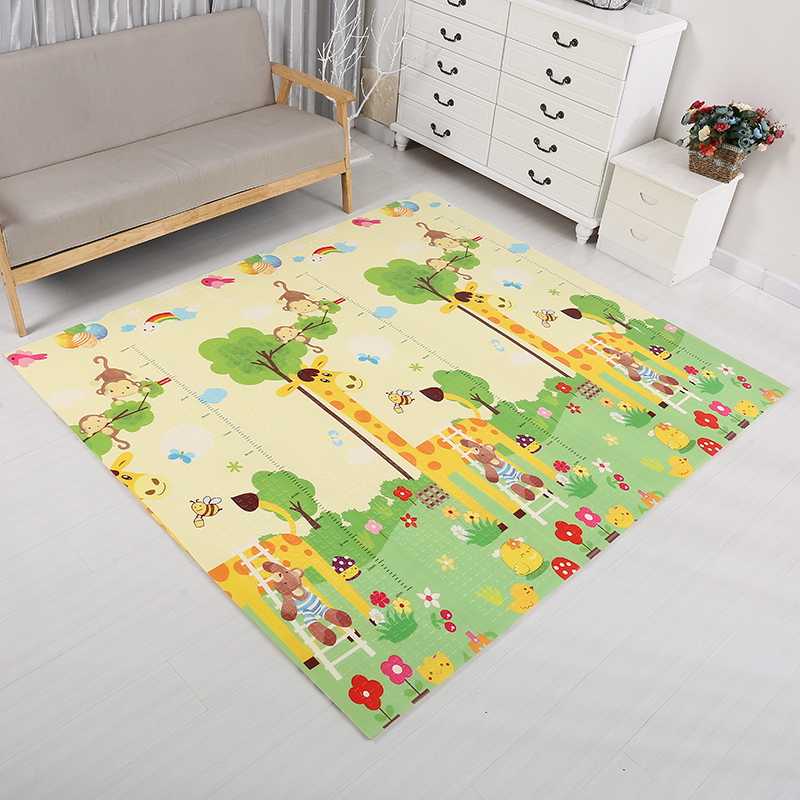
Once you determine your ideal square footage, you must select a format. XPE foam typically comes in two distinct styles. Each style handles large dimensions differently. Your choice directly impacts daily maintenance and long-term durability.
Foldable mats utilize a series of engineered creases. They collapse into themselves like a map. This design changes how you manage large surface areas in tight homes.
Features-to-Outcomes: It features accordion-style hinges. You can easily stash it behind a sofa or slide it under a tall bed. This modularity makes extra-large sizes incredibly viable for small apartments. You enjoy massive floor coverage during the day and reclaim your adult living space at night.
Drawbacks: Seams represent a structural compromise. They can trap dust, crumbs, and pet hair. Furthermore, these hinges occasionally separate under heavy lateral movement. When running toddlers stop abruptly, the individual panels can shift slightly, stressing the joints over time.
Rolling mats mimic traditional area rugs. They consist of a single, uninterrupted slab of closed-cell foam. An xpe rolling play mat delivers premium aesthetic appeal and ultimate structural integrity.
Features-to-Outcomes: It is one continuous, seamless piece. It offers superior liquid spill protection because liquids cannot seep into any crevices. You get a completely flat surface. It cleans easily with a single wipe.
Drawbacks: It is difficult to store daily. Rolling up a stiff foam cylinder takes effort. It requires dedicated vertical closet space. If you buy a large rolling mat, assume it will be a permanent fixture in the room. You will likely leave it unrolled 24/7.
Most buyers focus exclusively on length and width. They entirely ignore depth. However, thickness radically alters how a mat behaves in your home. It affects the overall weight. It dictates how easily you can move the unit. It also determines how much shock absorption your child receives.
This profile represents the industry baseline. It provides adequate cushioning for basic play.
It works best for large or extra-large sizes if the unit must be rolled or folded daily.
The lighter overall weight makes handling expansive sizes highly manageable. One parent can easily pick it up to vacuum underneath.
You sacrifice a tiny bit of ultimate impact protection but gain immense daily practicality.
Upgraded thickness delivers maximum peace of mind. It feels plush underfoot. It protects knees flawlessly.
It is ideal for aggressive motor development stages. When babies start standing and falling rigidly like little trees, premium depth absorbs the hit.
Implementation Risk: An extra-large mat at 0.8 inches thick is heavy. It becomes incredibly bulky. A rolled 0.8-inch mat creates a massive cylinder diameter. If you choose maximum thickness, consider sizing down slightly if you lack permanent, dedicated floor space.
Even cautious parents make sizing errors. Rushing the purchase process usually leads to frustrating returns. Avoid these specific pitfalls to ensure a perfect fit on your first attempt.
Buying for "Right Now" Instead of "Next Month": Do not purchase a small square strictly for a newborn. They grow incredibly fast. You will watch them outgrow the safe zone in merely four months. We highly recommend always sizing up one stage. If your budget and physical room space allow, buy the larger option. It saves money long-term.
Ignoring the "Edge Curl" Effect: Forcing a large xpe baby mat into a space slightly too small causes disaster. The edges ramp up forcefully against the walls. This creates a valley that traps dirt. Worse, it creates a rolling hazard for infants who might pin themselves against the elevated edge. Always respect the 12-inch buffer rule.
Underestimating Storage Realities: Buying an oversized rolling unit looks great online. However, parents often forget to measure their closet depth. They forget to check their under-couch clearance. When guests visit, you might suddenly realize you have absolutely nowhere to hide a massive foam cylinder. Measure your storage voids before evaluating your floor voids.
Choosing the correct dimensions requires honesty about your lifestyle. You must evaluate your child's current mobility level while anticipating their future needs. Balancing safety, aesthetics, and convenience ensures a smart investment.
Choose a Medium/Large Foldable style if you live in a multi-use space. It handles daily storage needs beautifully while keeping the living room versatile.
Choose an Extra-Large Rolling style if you have a dedicated playroom. It serves well if you prioritize a seamless, permanent aesthetic and ultimate spill protection.
Next-Step Action: Grab a roll of painter's tape right now. Tape out the exact dimensions of your shortlisted mat onto your floor. Walk around it. Test your daily walking paths. Open nearby doors to check swings. Verify your furniture clearance practically before ever clicking the checkout button.
A: No. Cutting XPE mats exposes the inner closed-cell foam core. This destroys the waterproof seal. It invites liquid penetration and bacterial growth. Furthermore, it creates a serious choking hazard as tiny bits of raw foam can peel away into your baby's hands.
A: Because XPE foam consists largely of microscopic air cells, it remains remarkably lightweight. Even a massive 79" x 70" unit typically weighs under 5 to 7 lbs. One person can easily lift it, fold it, or push it aside to vacuum the underlying floor.
A: Yes, in storage. A folded mat collapses down into a dense, compact rectangular block. You can slide it under beds easily. Conversely, a rolled mat remains a tall, rigid cylinder. It requires dedicated vertical closet space or an empty room corner.