
Views: 0 Author: Site Editor Publish Time: 2026-07-12 Origin: Site


Parents navigating the endless sea of baby gear face a tough choice when selecting safe floor coverage. You want a non-toxic surface for early childhood development. You often narrow the choice down to XPE foam. This cross-linked polyethylene material is excellent. However, you must pick a structural format. Do you want it to roll or fold? This choice creates significant divergence in daily usability. Your home aesthetic and maintenance routines rely heavily on this decision. Both formats share excellent safety and shock-absorption metrics. Choosing the wrong layout for your floor plan introduces daily friction. A bulky mat frustrates a small apartment dweller. A creased mat annoys someone who hates vacuuming crumbs. This article provides an objective evaluation. We compare an XPE rolling play mat against foldable alternatives. You will learn the specific use cases for each. We aim to help you finalize your purchasing decision confidently.
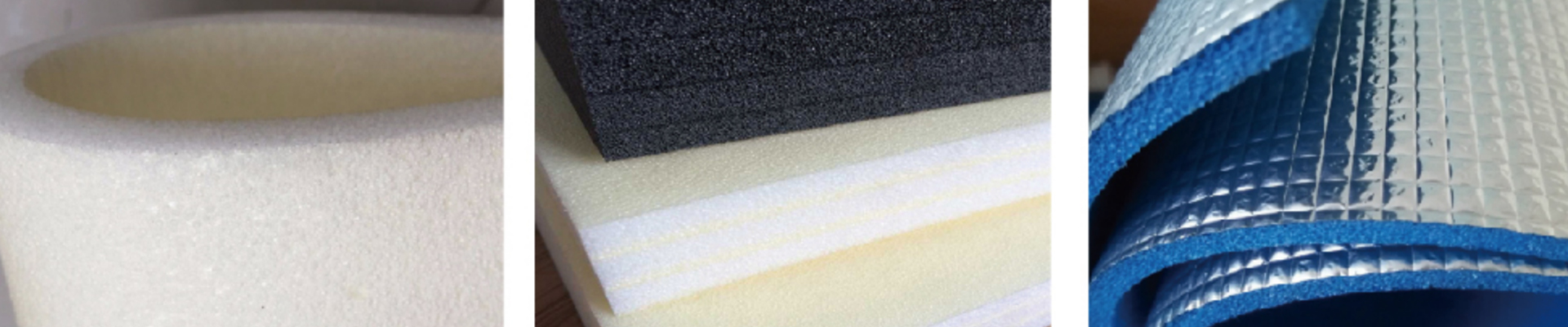
Before we compare the physical formats, we must understand the core material. Manufacturers produce XPE using a closed-cell foaming process. This specific method cross-links polyethylene molecules. It creates a highly durable, lightweight, and impermeable structure. The baby product industry considers XPE a gold standard. Independent testing consistently proves its safety profile.
Parents demand material transparency. XPE delivers peace of mind. It is inherently free of harmful chemicals. You will not find BPA, PVC, or phthalates in pure XPE. It also lacks heavy metals and formamide. These toxins often plague cheaper EVA foam puzzle mats. Pediatric experts recommend avoiding toxic off-gassing. Choosing XPE ensures you meet strict indoor air quality standards.
Performance metrics also favor XPE foam. It offers high-density shock absorption. This specific density is crucial for early motor development. A baby needs a firm surface for tummy time. They require a stable base for crawling. First steps demand reliable foot support. Too much cushion creates instability. Too little cushion results in painful falls. XPE strikes the perfect balance.
Furthermore, XPE provides excellent thermal insulation. Many parents have cold hardwood or tile floors. A baby loses body heat quickly on cold surfaces. The closed-cell structure traps room-temperature air. It blocks the cold draft from the floor below. This keeps your infant warm and comfortable during extended floor play.
Structural integrity defines the rolling format. Manufacturers produce these mats as a single, continuous sheet of foam. They eliminate structural weak points entirely. A seamless design offers massive advantages for home environments. Daily life puts heavy stress on baby gear. You need a product built to withstand constant use.
Pediatric physical therapists and osteopaths praise seamless mats. Motor development benefits significantly from a flat surface. A uniform floor provides reliable feedback. An infant relies on proprioception to develop balance. The subtle unevenness of fold lines confuses tiny feet. A seamless roll up baby play mat prevents this issue. Babies can shift their weight naturally. They learn to stand without navigating sudden ridges or dips.
Maintenance reality also heavily favors the rolling design. Spills wipe away cleanly in one motion. You never have to dig crumbs out of a crack. Liquid cannot seep into hidden seams. Homes with pets benefit greatly. Pet hair sweeps off the smooth surface effortlessly. Common household allergens find nowhere to hide. You can sanitize the entire mat in seconds.
However, we must address the implementation risks. Rolling mats are not perfect for every scenario. They present two primary challenges:
Best practices dictate reverse-rolling the mat upon arrival. We recommend laying heavy books on the corners. This accelerates the flattening process. Once flat, the seamless mat acts like a traditional area rug.
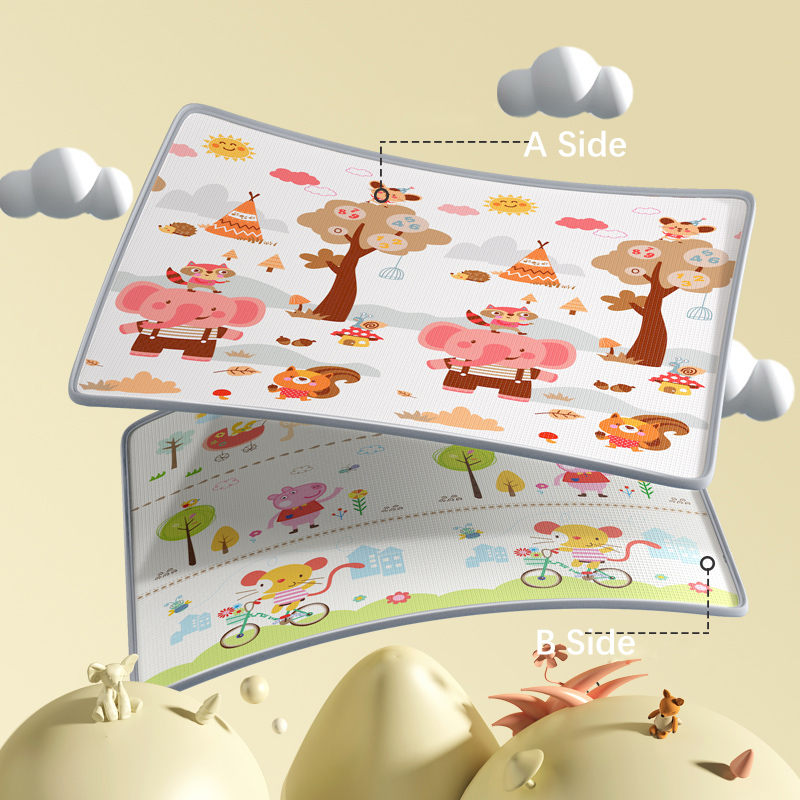
Modern living often requires spatial flexibility. Many families live in apartments. Others share a living room with a dedicated play space. An XPE foldable play mat solves the space constraint issue brilliantly. Deployment and storage take mere seconds. Accordion-style hinges connect the segmented foam blocks. You simply fold the sections together like a fan.
The resulting block is incredibly compact. You can easily slide it under a crib. It fits neatly into shallow closets. You can toss it into the trunk of a small sedan. This rapid breakdown capability is vital for nomadic households. If your child frequently visits grandparents, this portability is invaluable.
Foldable mats also offer unique modular use cases. You do not have to open the mat completely. You can partially fold it to fit inside a rigid playpen. Some parents fold it into a thicker block. This creates a multi-layered cushion for targeted activities. You can adapt the shape to fit awkward room corners.
Despite the convenience, foldable mats carry specific implementation risks. The folding mechanism introduces permanent weaknesses.
A common mistake involves vacuuming foldable mats. Rotating brush rolls easily catch the raised hinges. This tears the delicate top layer. You should only use smooth suction attachments on foldable designs.
We must compare these formats across three critical household categories. Your specific lifestyle dictates which features matter most. Aesthetically, the two formats look entirely different in a room. Hygiene demands vary based on your tolerance for deep cleaning. Durability expectations depend on pets and daily foot traffic.
Rolling mats integrate beautifully as semi-permanent decor. Double-sided designs feature modern rug patterns on one side. They feature child-friendly prints on the reverse. You can flip it to match your adult aesthetic. Foldable mats fundamentally look like temporary baby gear. The visible seams disrupt the visual flow of a living room. They look utilitarian rather than decorative.
Hygiene creates a stark contrast. The rolling mat offers a one-step wipe-down process. A damp cloth cleans the entire area instantly. The foldable mat requires a two-step process. You must wipe the main surface first. Then, you must stretch open each seam. You have to detail the hinges to remove trapped debris.
Durability favors the seamless option. Rolling mats resist localized wear effectively. Foldable mats succumb to friction at the seams. Pet claws and sliding toys catch on the elevated ridges. This friction severely shortens the lifespan of a foldable mat. Note that no XPE foam is completely immune to sharp pet claws. Unclipped dog nails will puncture both formats.
| Evaluation Category | XPE Rolling Format | XPE Foldable Format |
|---|---|---|
| Aesthetic Integration | Looks like a standard area rug. Smooth and seamless. | Looks like temporary baby gear. Visible segmented lines. |
| Cleaning Process | 1-step process. No crevices to trap dirt. | 2-step process. Seams require deep detailing. |
| Durability & Wear | High resistance. Wears evenly over time. | Moderate resistance. Hinges crack under heavy traffic. |
| Storage Footprint | Bulky cylinder. Hard to hide in small spaces. | Compact block. Fits easily under furniture. |
You now understand the strengths and weaknesses of each format. It is time to apply this knowledge to your household. Avoid buying based solely on aesthetics. Evaluate your daily routine honestly. Choose the mat that solves your primary pain point.
Choose an XPE rolling play mat if:
Choose an XPE foldable play mat if:
Regardless of the format chosen, follow crucial shortlisting advice. Verify the thickness before buying. We recommend a minimum thickness of 0.4 to 0.6 inches for hard floors. Thinner mats fail to provide adequate impact protection. Always look for reputable third-party toxicity certifications. Confirm the product passes CPSC safety standards.
Choosing between rolling and folding XPE mats impacts your daily life. The material safety remains identical across both formats. Your decision ultimately hinges on space, aesthetics, and cleaning preferences. A seamless mat elevates room design. A folding mat maximizes spatial efficiency.
For a primary residence where the mat remains stationary, choose the continuous surface. The rolling option offers a vastly superior return on investment. It provides better durability and effortless daily maintenance. For nomadic households or incredibly tight quarters, choose the foldable model. It represents a necessary, highly functional compromise.
Actionable Next Steps:
A: Unroll the mat completely in a warm room. The foam relaxes faster at room temperature. Carefully reverse-roll the tightly curled ends and hold for a few minutes. Lay the mat flat and place heavy objects, like hardcover books, on all four corners. It typically flattens completely within 24 to 48 hours.
A: The hazard is minimal but present. Fold lines create slight elevations and dips. Barefoot toddlers relying on proprioception might misjudge the surface. This minor unevenness rarely causes serious falls, but a flat rolling mat provides objectively better barefoot stability for early walkers.
A: It is difficult. A rolled mat forms a long, rigid cylinder, often 4 to 6 feet long. It rarely fits in a standard trunk. You usually have to lay down the back seats to accommodate it. Foldable mats are much better suited for car travel.
A: No foam mat is completely scratch-proof. XPE is highly durable, but unclipped pet claws will eventually puncture the surface. Seamless rolling mats fare slightly better because they lack exposed hinges. Elevated seams on foldable mats frequently catch claws and tear faster under pet traffic.