
Views: 0 Author: Site Editor Publish Time: 2026-05-29 Origin: Site


Walk into any martial arts supply store online. You will notice an extreme price disparity immediately. Buyers can find basic puzzle tiles for $15. Meanwhile, professional-grade options often exceed $40 per tile. For dojo owners and home-gym builders, purchasing the cheapest option feels very tempting. However, this choice routinely leads to rapid degradation. It compromises training quality. It heavily increases injury risks for athletes. Price variations in these products do not happen by chance. They are not driven by simple brand markup. Instead, measurable differences in material density drive the cost. Surface engineering plays a massive role. Seam stability and strict chemical compliance also dictate the final price. We will explore exactly why these manufacturing differences matter. You will learn how to evaluate mat specifications confidently. We will guide you toward making a safe, high-performance flooring investment for your facility.
High-end mats feature specific density ratings (e.g., Shore C 40-45) to support rapid pivoting without "squish," reducing ankle strain.
Premium surface textures prevent friction burns (rug burns) while offering enough grip for bare-foot striking martial arts.
Larger, commercial-grade tiles (1m x 1m) reduce seam count, significantly improving structural stability during intense sparring.
Budget mats often lack chemical safety certifications, risking exposure to formamide, phthalates, and heavy off-gassing.
Cheap generic mats are highly compressible. We often call this the "squish factor." When you train striking arts, excessive softness absorbs your kinetic energy. It causes the foot to sink deep into the foam. This sinking severely hinders the critical pivoting motion required for kicks. If your foot cannot rotate freely, the torque travels directly up your leg. This stresses your ankle and knee joints heavily. A common mistake among beginners is assuming softer flooring equals better joint protection. In reality, overly soft foam creates dangerous instability.
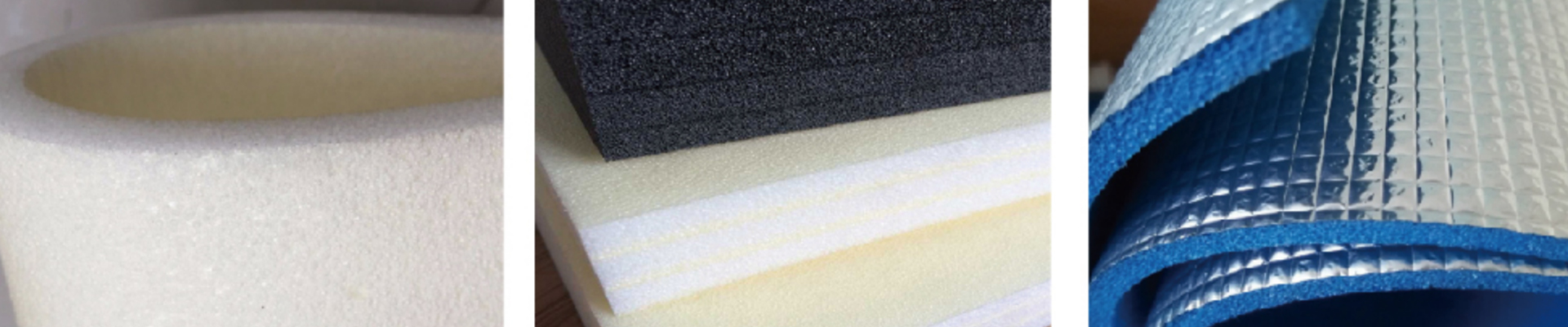
Professional taekwondo puzzle mats use high-density EVA foam. Industry standards require a Shore C hardness rating of 40-45. They also require a density of around 103 kg/m³. Manufacturers achieve this by compressing more raw EVA material into a thinner profile. This dense packing process increases raw material costs. It also requires more advanced heat-pressing machinery. Consequently, high-density mats cost more to produce than fluffy, air-filled budget mats.
This specific density provides a firm enough surface for explosive footwork. It retains enough core cushioning to absorb accidental falls. You get the perfect balance between stability and shock absorption. We can observe these differences clearly when comparing various foam grades.
Foam Grade | Shore C Hardness | Density (kg/m³) | Primary Use Case | Performance Outcome |
|---|---|---|---|---|
Budget/Generic | Under 30 | < 60 | Kids' playrooms, light stretching | Foot sinks; high ankle strain risk |
Mid-Tier | 30 - 38 | 70 - 90 | General home workouts | Moderate stability; wears out quickly |
Professional EVA | 40 - 45 | 100 - 110 | Taekwondo, Karate sparring | Firm base; optimal pivot support |
When you invest in proper density, athletes can execute roundhouse kicks smoothly. They maintain their balance during rapid lateral movements. The foam pushes back against their weight instead of collapsing.
The top layer of a mat dictates a large portion of its price. Manufacturing complexity increases significantly when creating specialized textures. Budget mats often use a simple stamped crosshatch pattern. This basic texture wears down very quickly. Worse, it often aggressively tears at the skin during ground contact. Low-end textures act like sandpaper when athletes slide across them.
Premium sports mats invest heavily in specialized surface engineering. Factories use customized molds to create precise textures. Two distinct finishes dominate the high-end market:
Tatami Texture: Mimics traditional Japanese woven straw. It provides maximum directional grip for bare feet. It prevents slipping during sweaty sparring sessions.
Thatch Texture: Features a softer, grass-like pattern. It offers excellent scuff resistance against martial arts shoes while remaining gentle on bare skin.
Smooth Finish: Completely flat surface. Facilities use this strictly for grappling arts to eliminate friction burns entirely.
Higher-priced mats feature advanced scuff-resistant treatments. Manufacturers design these specific top coats to withstand both bare feet and specialized martial arts shoes. Cheap mats will peel or shed foam dust after a few months of shoe traffic. Premium surfaces lock the foam structure together. They provide maximum grip while minimizing the risk of severe skin abrasions. These abrasions, often called rug burns, happen during incidental ground contact or tactical falls. A well-engineered surface protects both the athlete and the foam itself.
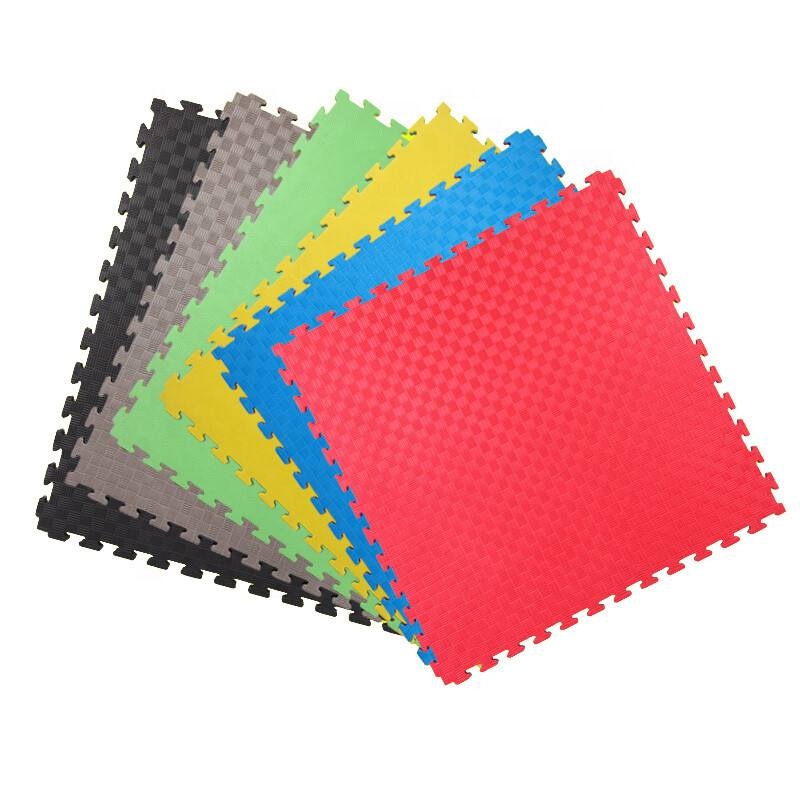
Consumer-grade mats typically come in small 24x24-inch squares. Professional martial arts mats use a standard 1x1 meter size. This measures approximately 3.28 feet by 3.28 feet. The larger size drastically alters the physics of your training floor. Size directly correlates to stability.
Larger mats mean fewer seams across the room. In a high-traffic dojo, athletes generate massive lateral forces. They push off the floor violently. When you have dozens of small tiles, you have hundreds of seams. These seams act as weak points. Fewer seams drastically reduce the chance of tiles separating under this lateral force. A separated seam creates a dangerous tripping hazard. It can instantly ruin a sparring match or cause a severe toe injury.
Premium 1x1 meter mats allow for rapid DIY installation. Precision-cut teeth ensure a tight, seamless lock. This tight tolerance requires expensive laser-guided cutting tools during manufacturing. The investment pays off during setup. You can assemble a professional floor quickly.
Follow these standard installation steps for optimal stability:
Sweep and level your subfloor completely before laying any foam.
Start in the most visible corner of your room to ensure a straight alignment.
Align the directional arrows printed on the underside of each tile.
Press the precision-cut teeth together firmly using your hands, avoiding heavy mallets.
Cut any edge pieces using a sharp utility knife and a straight metal edge.
This efficiency saves facility owners significant time. You avoid spending money on professional installation crews. The heavy-duty interlocking teeth will not stretch out over time. They keep your training surface cohesive and perfectly safe.
Chemical safety acts as the invisible price driver in martial arts flooring. Low-cost manufacturing often relies on cheap, toxic plasticizers. Factories use aggressive blowing agents to expand the foam quickly. These shortcuts lower production costs significantly. However, they introduce severe health risks into your training environment.
Premium EVA foam undergoes rigorous third-party testing. Manufacturers must ensure their products meet strict global safety standards. Safe mats must be entirely free of lead, latex, phthalates, and formamide. Achieving this level of purity requires expensive, highly refined raw materials. It also demands longer curing times in the factory.
Consider the regulatory standards reputable mats must pass:
Common Chemical Contaminants in Budget Foam | ||
Chemical Name | Manufacturing Purpose | Health Risk Mitigation |
|---|---|---|
Formamide | Used as a cheap foaming agent. | Reproductive toxin. Premium mats ban it. |
Phthalates | Used to soften brittle plastics. | Endocrine disruptor. Certified mats test 100% free. |
Lead | Found in low-grade color dyes. | Neurological risk. High-end mats use safe pigments. |
Uncertified budget mats often emit strong, lingering chemical odors. We call this process off-gassing. Off-gassing fills enclosed spaces with volatile organic compounds (VOCs). Training heavily in an off-gassing room causes headaches and respiratory irritation. Investing in compliant, tested mats acts as necessary liability protection. This holds especially true for commercial dojos hosting children's classes. Parents expect a non-toxic environment. Certified mats guarantee you provide one.
A budget mat degrades rapidly under stress. It may need replacing within 12 to 18 months of heavy use. The foam compresses permanently. The surface texture peels away. High-quality mats maintain their structural integrity for years. They survive extreme environments easily. You can place them in unheated garages with severe temperature fluctuations. The high-density EVA resists expanding and contracting. It stays flat and reliable.
Premium mats offer universally reversible designs. You typically find them in red/blue or black/grey combinations. This dual-color utility provides immense practical value. Facility owners use contrasting colors to create visual sparring boundaries. You can map out designated training zones without buying tape or paint. If someone drops a heavy weight and damages a single tile, you do not need to discard it. You simply flip the damaged tile over. It looks brand new again. This clever design doubles the usable lifespan of your floor.
Maintenance overhead also differs wildly between price tiers. Cheaper porous mats act like giant sponges. They absorb sweat, spilled water, and ambient humidity. This moisture breeds bacteria rapidly. Porous mats require aggressive, time-consuming cleaning protocols. Over time, heavy scrubbing breaks down the cheap foam completely.
Professional mats feature moisture-repellent, closed-cell construction. Sweat stays entirely on the surface. Bacteria cannot penetrate the foam core. You only need simple sweeping and mild soap to keep them pristine. This closed-cell technology lowers daily maintenance labor drastically. Your staff spends less time cleaning. Your mats stay hygienic, fresh, and structurally sound year after year.
The price of a taekwondo mat directly correlates to its structural engineering. Savings on budget mats vanish quickly when you face frequent replacement costs. Cheap foam also compromises your fundamental training quality and athlete safety. High-density EVA foam ensures you can pivot safely without joint strain. Premium surface textures protect your skin while providing essential grip. Moreover, strict chemical compliance keeps your indoor air quality pristine and safe for children.
You should always measure your floor space accurately before ordering. Assess whether your facility focuses strictly on stand-up striking or mixed martial arts. Finally, always request a density specification sheet from your supplier before purchasing. Verifying the Shore C hardness ensures you receive true commercial-grade quality.
A: 20mm (approx. 3/4 inch) is the industry standard for striking arts like taekwondo and karate, providing maximum stand-up stability. 40mm is required if your training incorporates heavy grappling, judo throws, or MMA groundwork.
A: Yes. However, for extreme budget or high-impact setups, a common practitioner solution is to layer a standard carpet padding underlayment between the concrete and the EVA mats to increase shock absorption without compromising the firm top surface.
A: Use a damp mop with a mild, neutral soap. Never allow standing water to pool on the seams, and strictly avoid harsh chemical solvents, floor wax, or motorized scrubbers, which will strip the protective texture.