
Views: 0 Author: Site Editor Publish Time: 2026-07-11 Origin: Site


Evaluating products for infants is a high-stakes reality for parents today. You constantly balance chemical safety against physical protection and daily practicality. Finding this perfect middle ground often feels overwhelming. Recently, Cross-linked Polyethylene (XPE) foam emerged as a superior alternative to traditional PVC and EVA foams. This specialized closed-cell material eliminates many historical safety concerns in the infant market. It provides excellent cushioning without relying on harmful chemical additives. We will break down the material science behind these popular products objectively. You will learn about their specific physical support criteria. We will also explore the daily implementation realities you face at home. This comprehensive guide helps you make an evidence-based purchasing decision for your child.
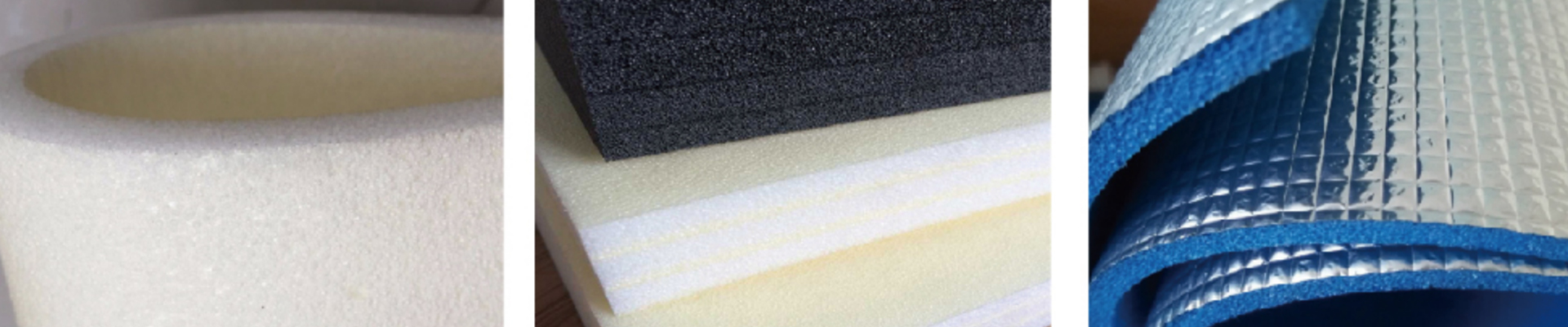
To understand foam safety, we must look at the manufacturing process. XPE stands for cross-linked polyethylene. Manufacturers use a thermal foaming process to create it. Heat forces the polyethylene molecules to bond together. This bonding is the "cross-linking" phase. It creates a highly stable, closed-cell structure. Traditional foam manufacturing often requires chemical blowing agents or toxic glues. XPE skips these dangerous steps entirely. The heat does the heavy lifting. This structural stability means the foam holds its shape naturally. It does not need chemical reinforcements.
This process results in crucial chemical exclusions. Parents often worry about hidden toxins in baby gear. Because of its thermal bonding, XPE eliminates several specific hazards. It contains zero PVC. It has no BPA. You will find zero phthalates. It is completely free of formamide. Formamide is a toxic chemical historically found in cheaper EVA puzzle mats. By removing these legacy materials, XPE offers a fundamentally cleaner surface. For parents exploring floor coverage, a quality XPE rolling play mat delivers unparalleled peace of mind.
Parental skepticism often peaks around foam smells. Unboxing a new mat usually releases a distinct scent. Many parents immediately assume this smell equals toxic off-gassing. This is a common misconception. The initial scent comes from harmless trapped manufacturing air. It is not harmful Volatile Organic Compounds (VOCs). High-quality XPE is fully VOC-compliant. The manufacturing scent dissipates rapidly. It usually disappears within a few hours in a well-ventilated room. Contrast this with older EVA foams. They can emit chemical odors for weeks.
You should never trust marketing claims blindly. Always look for independent verifications. Manufacturers must prove their safety standards through third-party testing. Instruct your search by looking for these specific certifications:
Common Mistake: Assuming all foam mats are identical. Always check the manufacturer's specification sheet for these exact acronyms before completing a purchase.
A safe play area requires a delicate biomechanical balance. We call this the shock-absorption to firmness ratio. Crawling babies are essentially tiny athletes learning coordination. They fall frequently. They experience sudden head strikes against the floor. A mat must absorb the heavy impact of these sudden falls. However, it must also remain highly firm. If a mat is too soft, the baby sinks into the foam. Sinking impedes wrist and knee stabilization. When joints sink, the baby has to work twice as hard to push up. This leads to fatigue and frustration. High-density XPE functions much like a firm yoga mat. It bounces back instantly. It supports the skeletal structure properly during tummy time.
Thickness standards frame the evaluation criteria for any solid option. Industry experts consider 0.4 to 0.6 inches (1 to 1.5 cm) the absolute sweet spot. Why this specific range? It perfectly balances cushioning with trip-hazard reduction. If a mat is thicker than 0.6 inches, it creates a steep drop-off at the edges. Toddlers catch their toes on high edges easily. When choosing an XPE rolling play mat,baby crawling mat, density matters just as much as raw thickness. A dense 0.5-inch mat protects a child far better than a cheap, airy 1-inch mat. It stops the impact from traveling through to the hard floor below.
Beyond impact protection, we must address thermal insulation. Hardwood and concrete floors sap body heat rapidly. Babies spend hours close to the ground. They lose heat much faster than adults do. The closed-cell structure of XPE acts as a powerful thermal barrier. Millions of tiny, sealed air pockets block cold air from rising. They reflect the ambient room temperature back to the infant. This creates a consistently safe, warm microclimate for play.
Here is a practical breakdown to help you evaluate thickness options based on your primary flooring.
| Primary Floor Type | Recommended Mat Thickness | Primary Benefit |
|---|---|---|
| Carpet | 0.4 inches (1 cm) | Adds firmness over soft carpet; prevents joint sinking. |
| Hardwood / Laminate | 0.5 inches (1.2 cm) | Ideal balance of head-strike absorption and thermal insulation. |
| Concrete / Tile | 0.6 inches (1.5 cm) | Maximum thermal barrier; highest impact protection for hard falls. |
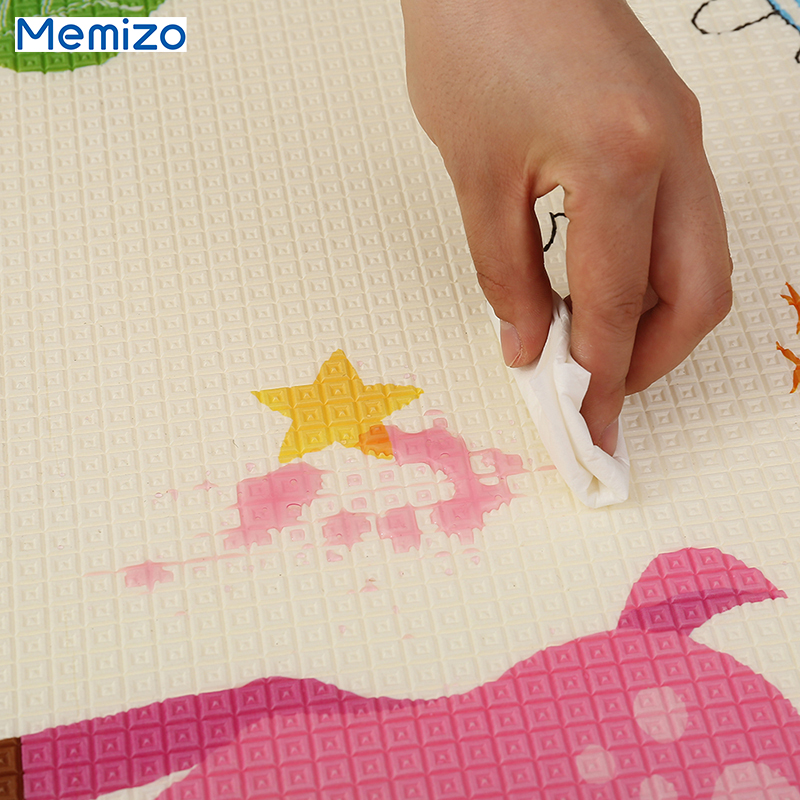
One of the most common complaints on parenting forums involves traction. Babies often slip on perfectly smooth foam surfaces. They try to push forward, but their knees slide backward. Manufacturers solve this by pressing micro-textures into the XPE. They use heated rollers to emboss geometric grids, raised letters, or tiny diamonds onto the surface. This texture creates necessary friction. It gives tiny toes and knees something to grip when pushing off.
However, adding friction creates a new challenge: skin integrity. Bare infant skin is incredibly delicate. The anti-slip texture must strike a careful balance. It needs to be shallow and rounded. If the grooves are too deep or the edges too sharp, they act like sandpaper. Aggressive crawling on abrasive textures causes friction burns on little elbows and knees. Quality XPE mats use soft-edge embossing. You can test this by rubbing the back of your own hand firmly across the mat. It should feel bumpy but never scratchy.
Fluid resistance heavily influences slip hazards during daily use. Babies produce constant moisture. Drool, spit-up, and spilled milk are daily realities. XPE is 100% waterproof. Because of its closed-cell nature, liquids cannot penetrate the surface. Instead, fluids pool on top. While this makes the mat highly hygienic, it creates temporary slip hazards. Moisture trapped between a textured mat and a baby's skin reduces friction to zero. You must wipe up spills promptly to maintain the surface grip.
Parents face a saturated market filled with confusing acronyms. Comparing materials side-by-side reveals the true value of XPE. First, let us look at EVA (Ethylene-Vinyl Acetate). EVA is historically cheaper. You usually find it in interlocking puzzle mats. However, EVA often contains formamide to make it soft. It degrades faster under UV light. The printed films on EVA are highly prone to peeling over time. XPE offers significantly better chemical safety. It also boasts a much longer functional lifespan.
Next, we must compare XPE to TPU (Thermoplastic Polyurethane). TPU sits at the premium end of the market. It is heavily dense. It is highly durable against pet claws. A TPU mat lays completely flat the moment you unroll it. However, TPU comes at a significantly higher price point. It is also quite heavy. You cannot easily roll it up and hide it behind a sofa. XPE is the lighter alternative. It provides comparable non-toxic benefits but remains highly budget-friendly. It is ideal for families who need to clear the living room space daily.
Finally, consider Fabric or Cotton mats. Fabric offers undeniable aesthetic value. They look beautiful in nurseries. You can throw them straight into the washing machine. Unfortunately, fabric offers zero impact protection. A baby falling backward on a cotton mat will still hit the hard floor underneath. Furthermore, fabric offers zero wipeability. Every minor spill requires a full laundry cycle. This makes them impractical for aggressive daily use.
Use the chart below to visualize how these four common materials stack up against each other.
| Material Type | Impact Protection | Chemical Safety | Wipeability | Price Tier |
|---|---|---|---|---|
| XPE Foam | High | Excellent (Zero VOC/PVC) | 100% Waterproof | Mid-Range |
| EVA Foam | Medium | Poor (May contain formamide) | Water-Resistant | Budget |
| TPU Foam | High | Excellent (Medical Grade) | 100% Waterproof | Premium |
| Fabric / Cotton | None | Good (If organic) | Requires Machine Wash | Varies |
This comparison frames the final shortlisting logic. XPE serves as the pragmatic middle ground. It perfectly suits buyers who prioritize strict non-toxic compliance and easy cleaning. It gives you premium-level safety without forcing you into the expensive TPU price bracket.
Daily use exposes the true functionality of any baby product. The greatest advantage of a rolling mat is its seamless design. Contrast this immediately with folding mats or puzzle mats. Folding mats have deep crevices at every hinge. Puzzle mats have hundreds of interlocking teeth. These seams trap household dust. They catch pet hair. They harbor spilled milk and trapped liquids. This creates massive hygienic blind spots. Bacteria thrive in these dark, damp crevices. A seamless rolling design eliminates these traps entirely. It drastically reduces bacterial growth risks.
We must transparently address the main implementation annoyance: the edge curl risk. XPE foam has physical memory. When manufacturers ship it, they roll it tightly into a cylinder. The foam remembers this curved shape. When you first unroll it in your living room, the outer edges will naturally curl upward. This curling creates a temporary tripping hazard. It frustrates many new buyers who expect it to lay perfectly flat on day one.
You can manage this easily with a simple mitigation strategy. Give the foam time to relax. Reverse-roll the mat loosely in the opposite direction for a few hours. Unroll it and place temporary weights, like heavy books, on the four corners. Keep the room reasonably warm. Heat softens the molecular bonds slightly. A warm room helps the foam lose its curved memory faster. Typically, the mat settles completely within 48 hours.
You must also set realistic expectations regarding household pets. Durability has limitations. XPE is highly puncture-resistant to blunt impacts. Dropped wooden blocks or heavy plastic toys will not pierce it. However, it remains vulnerable to piercing forces. Sharp cat claws will puncture the top film. Heavy dogs launching themselves off the mat can leave permanent scratches. Sharp furniture legs will create lasting indentations. If you have aggressive pets, you must keep them out of the play area. No lightweight foam can withstand sharp claws indefinitely.
An XPE rolling play mat successfully merges structural safety with strict chemical safety. It gives your infant firm impact absorption for their developing joints. It ensures they breathe clean, hypoallergenic, VOC-free air during tummy time. It solves the hygienic nightmares associated with traditional puzzle mats.
You should finalize your decision by matching your specific household constraints against these verified attributes. Evaluate your budget. Measure your daily storage space. Honestly assess the presence of sharp-clawed pets in your home. XPE handles almost all daily infant challenges beautifully, provided you protect it from animal damage.
Take action before adding any mat to your cart. Check the manufacturer's specific product listings. Look directly for third-party toxicity testing badges like GREENGUARD Gold or OEKO-TEX. Verifying these documents guarantees you bring a truly safe surface into your family’s home.
A: Yes, it is highly safe for newborns (0+ months). The dense foam provides the necessary firm support. It prevents their bodies from sinking. This firmness gives them the leverage needed to push up safely. It actively aids in strengthening their neck and shoulder muscles during early motor development.
A: It typically takes 24 to 48 hours for the material to relax fully. You can speed up this process significantly. Reverse-roll the edges gently. Place heavy books on the corners. Keeping the room warm also helps the foam release its physical memory much faster.
A: Use a soft cloth with mild dish soap and warm water. Wipe it down daily. Avoid harsh bleach, alcohol-based sanitizers, or abrasive scrub brushes. These aggressive chemicals and stiff bristles will degrade the waterproof film and strip the printed design over time.
A: Yes, it is vulnerable to sharp objects. While it resists blunt impacts from toys, sharp cat claws or heavy dog nails can puncture the outer layer. If you have highly active pets, you must restrict their access to the mat, or consider upgrading to a heavier, claw-resistant TPU option.