
Views: 0 Author: Site Editor Publish Time: 2026-07-01 Origin: Site


Industrial packaging forces a harsh compromise every day. You must protect delicate products from brutal transit conditions without inflating dimensional weight freight charges. Every ounce of heavy packaging drains profitability, yet insufficient protection destroys customer trust.
Many packaging engineers still rely on brittle commodity foams or over-engineered specialty polymers to solve this problem. These extremes leave businesses trapped. They face high damage rates on one end or exorbitant material expenses on the other. Finding a middle ground remains a constant challenge across global supply chains.
Expanded Polyethylene (EPE) has emerged as the dominant solution to bridge this critical gap. This article provides a comprehensive evaluation framework for procurement teams and packaging engineers. We will explore whether this specific polymer suits your exact industrial applications and how to maximize its protective capabilities.
Before adopting new materials, we must analyze the specific failures of legacy options. Industrial environments expose packaging to continuous vibration, secondary impacts, and harsh climatic shifts. Traditional materials often struggle to maintain their integrity under these compound stresses.
Manufacturers often specify Expanded Polystyrene (EPS) simply because it feels cheap upfront. However, hidden expenses quickly pile up on the factory floor and the end-user destination. EPS suffers from extreme brittleness. It crumbles under stress or twisting forces. This crumbling creates severe particulate contamination. Micro-beads scatter across assembly lines, finding their way into sensitive electronics or lubricated machine parts. Furthermore, end-users despise the unboxing friction associated with styrofoam. Cleaning up a mess of broken white foam damages brand equity and creates a frustrating customer experience.
Polyurethane (PU) presents a different set of challenges. Open-cell PU feels incredibly soft. It cushions lightweight, delicate items beautifully. But engineers often overprescribe it. Open-cell PU acts like a sponge. It absorbs ambient moisture, which can lead to rapid corrosion of metal parts during transit. Additionally, it fails completely under heavy loads. Heavy industrial components compress the soft foam entirely, transferring shock directly to the product. Volumetric costs also skyrocket. You end up paying a premium for a performance profile you do not actually need.
Modern packaging requires a strict set of performance metrics. We can measure success through three specific outcomes. First, the material must deliver zero-abrasion surface protection. Second, it must provide reliable, multi-drop shock absorption. Third, it needs to maintain stable tooling expenses during fabrication. Meeting these aggressive demands requires shifting away from brittle or overly soft polymers toward a more balanced structural solution.
Understanding the physical properties of packaging helps engineers forecast real-world performance. The unique molecular structure of this polymer dictates how it behaves in transit. Let us break down the physical characteristics of epe material and map them directly to measurable business outcomes.
The manufacturing process traps millions of tiny air pockets within the polyethylene structure. These closed cells do not share walls or interconnect. This independence provides consistent load-bearing capability. It also creates an impermeable barrier against water and humidity.
Commodity foams crush flat upon impact and stay flat. EPE possesses excellent elastic memory. When a courier drops a box, the material compresses to absorb the kinetic energy, then quickly rebounds to its original shape. It resists tearing even under high tensile strain.
The texture remains remarkably soft and non-scratching, despite its structural rigidity. It glides smoothly against delicate finishes.
This polymer demonstrates strong resistance to a wide variety of industrial chemicals. It does not degrade when exposed to common oils, heavy greases, or manufacturing solvents.

Procurement teams must match the physical form of the material to the specific application. Choosing the wrong form factor inflates shipping costs and wastes warehouse space. We categorize these solutions into three distinct families.
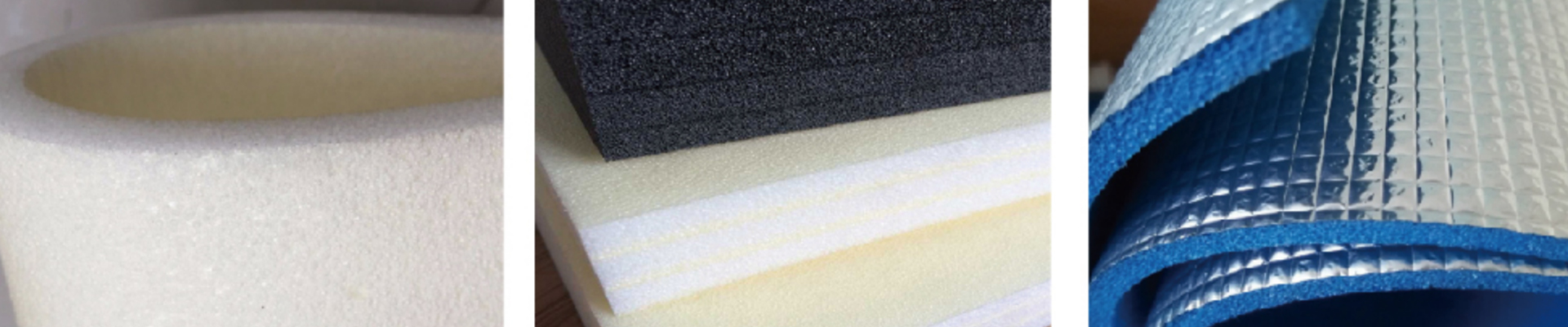
Fabricators start with large, thick planks or laminated sheets. These thick formats provide the structural foundation for heavy-duty protection. They serve as the blank canvas for complex manufacturing techniques like CNC routing, steel-rule die-cutting, and waterjet cutting.
You should specify custom EPE foam when you need exact part containment. We call this shadow-boarding. The foam acts as a cradle, locking the component in place. Ideal applications include heavy electronics transit cases, reusable automotive dunnage trays, and heavy appliance end-caps that require rigid corner support.
Extruding the material into thin, flexible layers creates a completely different product. Rolls offer continuous, wrap-around surface protection. They excel at interleaving between stacked items or serving as flexible void fill inside oversized cartons.
You should specify protective EPE foam rolls when packing long, awkward items. Ideal applications include wrapping extruded aluminum profiles, protecting wooden furniture during shipping, and providing a buffer layer for large-panel glass or solar panels.
Sometimes you only need targeted protection. Manufacturers can extrude this material into U-channels, L-shapes, or custom edge protectors. They can also laminate different densities together. For instance, a hard outer layer absorbs sharp impacts, while a softer inner layer cradles the product. These bonded blocks work perfectly for targeted corner protection on large server racks or heavy industrial machinery.
Application Matching Guide
| Form Factor | Primary Fabrication Method | Best Use Case | Relative Cost Level |
|---|---|---|---|
| Custom Sheets/Planks | CNC Routing, Die-Cutting | Complex geometries, heavy part cradling | High (requires tooling/machining) |
| Thin Rolls | Slitting, Perforating | Surface wrapping, interleaving | Low (commodity volume pricing) |
| Extruded Profiles | Direct Extrusion | Edge and corner impact protection | Medium |
Engineers often express skepticism when switching materials. They worry about losing performance or overspending. We must objectively evaluate how this material stacks up against other popular polymers. Let us look at the evidence-based shortlisting logic.
Cross-linked polyethylene (XLPE) sits at the top of the performance pyramid. The chemical cross-linking process creates an incredibly smooth, aesthetically flawless finish. It seals completely watertight and resists extreme chemical exposure. Military specifications and high-end medical cases often mandate XLPE.
The reality, however, comes down to budget constraints. XLPE costs significantly more. It also proves incredibly difficult to recycle because the chemical bonds cannot easily melt down. EPE provides 80% of the shock absorption performance for a fraction of the price. Choose EPE unless visual perfection, extreme chemical resistance, or strict mil-spec compliance drives your project.
EVA foam feels dense, heavy, and undeniably premium. When you open a luxury watch box or high-end consumer electronics packaging, you touch EVA. It presents beautifully.
The reality is different for industrial applications. EVA adds unnecessary weight to freight shipments. It costs more per cubic inch. EPE provides vastly superior cushioning for heavier items per dollar spent. You use EVA to impress a consumer. You use EPE to ensure a 50-pound industrial motor survives a cross-country truck journey.
Use this quick heuristic to rule out options immediately:
Selecting the right material only solves half the problem. You must also navigate the complexities of fabrication, supply chain logistics, and quality control. Demonstrating expertise requires understanding these implementation realities.
Density dictates performance. However, many engineers make a critical error: they assume higher density always equals better protection. We must look at the math of static loading. Static loading measures how much weight the foam bears per square inch.
If you put a lightweight circuit board on high-density foam, the foam acts like a brick. It will not compress. The shock transfers directly into the circuit board, breaking it. Conversely, if you put a heavy steel gear on low-density foam, it "bottoms out." The foam flattens completely, offering zero protection. You must calculate the exact item weight and match it to the correct foam density to ensure optimal cushioning.
Fabrication methods carry different financial profiles. Steel-rule die-cutting requires you to purchase custom metal stamps (dies). This means high upfront tooling costs. However, once built, the dies stamp out thousands of parts in minutes, resulting in a very low unit cost.
CNC routing, on the other hand, requires zero tooling costs. A computer guides a spinning bit to carve the foam. It handles complex 3D shapes easily. But CNC routing takes time. The unit cost runs much higher.
Common Mistake: Failing to account for dimensional tolerance variations. Foam is soft and inherently unstable during cutting. Typical fabrication tolerances range from +/- 1/16” to 1/8”. Never design foam cavities with the exact tight tolerances you would use for machined metal parts.
Shipping foam essentially means shipping air. Foam is lightweight but bulky. A truckload might hit its maximum volumetric capacity while only carrying a few thousand pounds. This freight inefficiency destroys budgets.
Best Practice: Utilize regional sourcing networks. Keep fabrication close to your assembly plant. Alternatively, purchase dense, skived sheets (thinly sliced layers stacked tightly) and fabricate them in-house. This optimizes truckload utilization and keeps Minimum Order Quantities (MOQs) manageable.
Standard polyethylene builds up static electricity through friction. This spells disaster for printed circuit boards. Always specify Anti-Static additives for electronics packaging. The industry universally dyes these anti-static batches pink. Pink foam safely dissipates electrostatic discharge (ESD) events, ensuring microchips arrive fully functional.
Navigating the industrial packaging landscape requires strategic thinking. We must move beyond outdated legacy materials. Expanded Polyethylene represents the most balanced choice for modern manufacturers. It delivers durable, multi-impact protection without carrying the premium price tag of cross-linked polymers. It protects your products from abrasion, withstands harsh transit drops, and keeps freight costs manageable.
Take the following action-oriented steps to advance your packaging strategy:
A: Yes, it is a Category #4 plastic (LDPE). It is 100% recyclable, both physically and chemically. Facilities can melt it down to create new plastic products. However, adoption strictly depends on local municipal or industrial recycling infrastructure capabilities, as bulky foam requires specialized compaction equipment before processing.
A: Yes, fabricators easily manipulate it. They heat-weld it to itself to create deep, complex cavities without using toxic glues. They also laminate it to corrugated cardboard, plastic films, or aluminum foil to enhance structural integrity, thermal resistance, or aesthetic appeal.
A: Standard protective rolls typically range from 0.9 to 1.2 PCF (pounds per cubic foot). This low density provides excellent flexibility for wrapping. In contrast, rigid die-cut sheets generally utilize 1.5 to 2.2 PCF densities to support heavier structural loads and maintain tight cavity dimensions.
A: Modern manufacturing processes expand the polymer using physical blowing agents, such as butane, rather than ozone-depleting chemical CFCs. Consequently, the finished material is safe, odorless, non-toxic, and fully compliant with modern global environmental packaging regulations.