
Views: 0 Author: Site Editor Publish Time: 2026-05-31 Origin: Site


Many buyers mistakenly believe thicker flooring automatically guarantees better safety. They assume extra padding inherently prevents injuries across all martial arts. This assumption often leads to poor facility upgrades and increased injury rates.
Taekwondo presents very distinct biomechanical demands. Athletes execute rapid footwork, high-impact jump kicks, and continuous spinning on the ball of the foot. These rapid movements require solid ground contact. You need explosive energy return to pivot safely and strike effectively.
Selecting the correct taekwondo puzzle mats requires balancing firmness for ankle stability. You need just enough impact absorption to protect joints upon landing. This guide will help you choose the exact specifications required to enhance agility. You will learn why avoiding overly soft materials is crucial for stand-up striking arts.
The optimal thickness for pure Taekwondo training is 20mm (approx. 3/4 inch) to 25mm (1 inch).
Thicker mats (1.5 inches+) increase the risk of rolled ankles and sluggish movement during stand-up striking.
Foam density (aiming for ~100kg/cbm) and hardness (Shore C 40-50) dictate durability and joint protection more than raw thickness.
Surface texture must allow for smooth rotational movements (spins) without causing friction burns or catching toes.
A persistent myth dominates the martial arts equipment industry. Many facility owners believe thicker padding provides superior overall protection. This logic applies well to high-amplitude grappling arts like Judo or Brazilian Jiu-Jitsu. However, it fails completely when applied to striking disciplines.
Stand-up striking arts rely heavily on ground reaction force. Taekwondo practitioners constantly push off the floor to generate kinetic energy. The biomechanical reality is quite simple. A floor surface absorbs kinetic energy if it compresses too deeply. Athletes lose their explosive speed. Their footwork becomes visibly sluggish. Training on an overly thick surface feels similar to running on dry sand.
Implementing 1.5-inch or 2-inch padding creates severe implementation risks for a pure striking facility. Deep compression occurs under the athlete's body weight. This compression creates micro-divots around the foot. When an athlete attempts to pivot rapidly, these micro-divots trap the foot.
Trapping the foot during a high-speed spin drastically increases the likelihood of rolled or sprained ankles. The knee joint also absorbs immense lateral torque when the foot cannot rotate freely. Over-padding directly causes these preventable joint injuries.
Grappling Requirements: Need thick padding (1.5" to 2") to disperse blunt force from heavy body falls and takedowns.
Striking Requirements: Need thin, firm padding (under 1") to facilitate fast pivots and immediate energy return.
We must redefine what protection actually means in this specific context. In grappling, protection means guarding the spine and skull from heavy throws. In Taekwondo, the protective function serves a completely different purpose.
The primary goal is mitigating repeated stress on the knees and ankles. Athletes land hundreds of jump-kicks during a single training session. The sports mats must absorb the sharp, downward shock of these landings. You need just enough shock absorption to prevent micro-fractures in the tibia and fibula. You do not need deep spinal crash protection.
Choosing the correct thickness requires matching the material to your primary training style. Different training environments demand different floor profiles. Industry standards exist to help you navigate these choices.
Professional facilities typically use thicknesses between 20mm and 25mm. This range acts as the established industry baseline for high-traffic dojangs. At this exact depth, closed-cell EVA foam delivers peak performance. It provides adequate shock absorption for stand-up sparring.
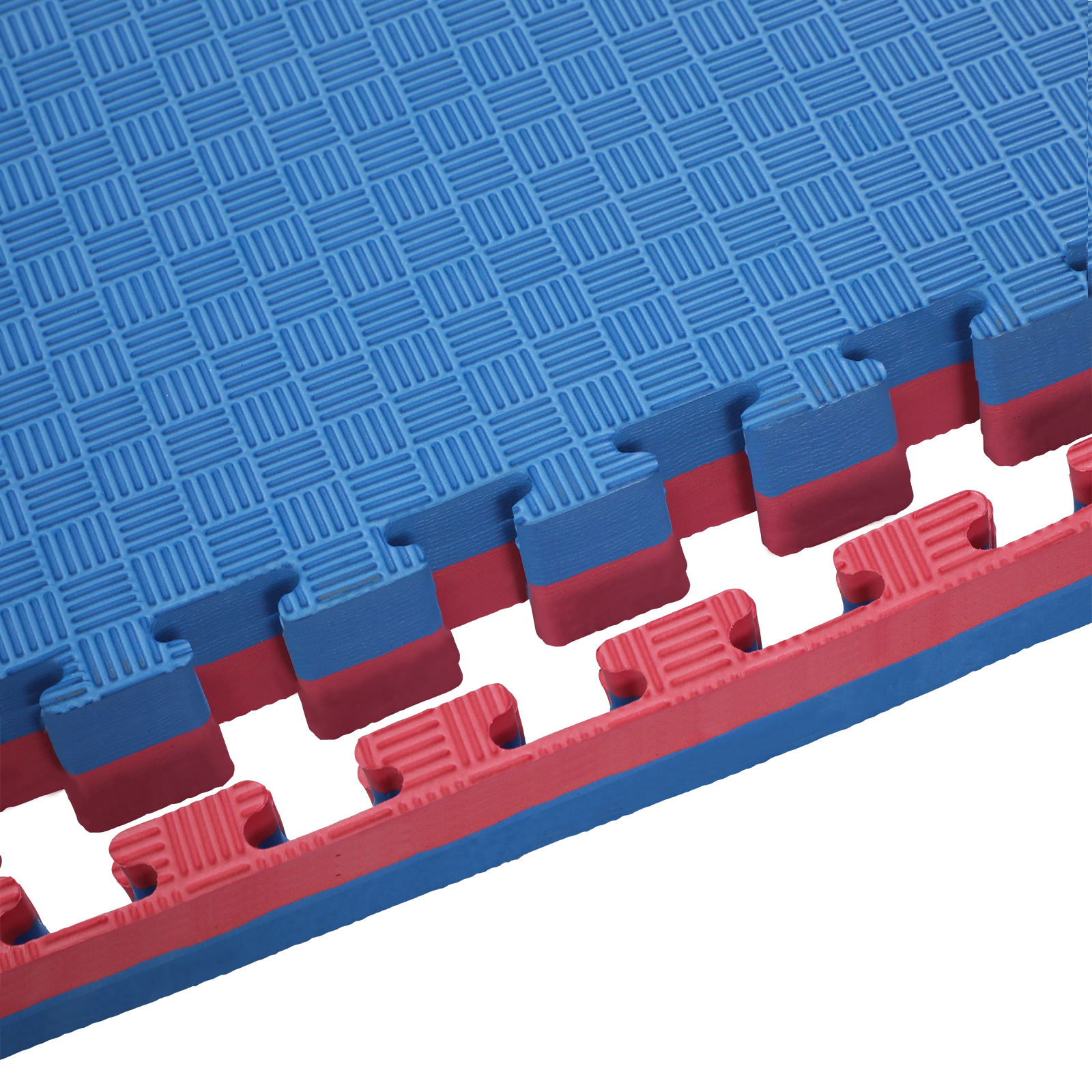
Crucially, 1-inch flooring maintains structural firmness. Athletes can bounce, slide, and pivot without experiencing any noticeable sinkage. The interlocking edges remain perfectly flush because the material does not compress unevenly. This baseline thickness effectively balances agility with joint safety.
Many students build personal training spaces in their basements or garages. Standard 20mm options generally suffice for home use. However, you must carefully evaluate your subfloor.
Raw, uneven concrete presents a unique challenge. Concrete offers zero inherent give. If your home gym features bare concrete, consider upgrading to a slightly denser 25mm option. The extra 5mm provides a necessary buffer against the rigid subfloor below.
Some modern facilities operate as hybrid training centers. They might cross-train in MMA, basic takedowns, or self-defense alongside traditional striking. These hybrid use cases complicate the flooring decision.
If your curriculum includes regular judo throws, a slight increase in thickness becomes a necessary compromise. You might need to install 1.25-inch or 1.5-inch flooring. You will sacrifice some pure agility in your kicks. However, you gain the minimum required protection to prevent concussions during takedown drills.
The chart below summarizes how different training focuses align with recommended thicknesses.
Primary Discipline | Recommended Thickness | Primary Benefit | Risk Factor |
|---|---|---|---|
Pure Taekwondo / Karate | 20mm - 25mm (0.79" - 1") | Maximum agility, fast pivots, ankle stability. | Insufficient for high-impact body throws. |
Hybrid (Striking + Basic Takedowns) | 30mm - 40mm (1.25" - 1.5") | Balanced impact dispersion for light falls. | Slight sluggishness during jump kicks. |
Grappling / Judo / BJJ | 40mm - 50mm (1.5" - 2.0") | Maximum protection against head/spine impacts. | High risk of ankle sprains during fast striking. |
Evaluating thickness alone provides an incomplete picture. Two completely different products can measure exactly one inch thick but perform entirely differently. You must understand density and hardness to make an informed purchasing decision.
Foam density refers to the mass of the material per cubic meter (kg/cbm). Density determines how much impact resistance the floor provides. A phenomenon known as the "push-back effect" occurs when athletes land heavily.
High-density foam aggressively resists compression. It pushes back against the athlete's weight. This resistance prevents practitioners from "bottoming out" and striking the hard subfloor beneath. Typically, manufacturers aim for a density around 100kg/cbm for premium sports mats.
A high-density 1-inch product is vastly superior to a low-density 1.5-inch product. The softer, thicker material will bottom out quickly, offering zero real protection despite its visual bulk.
We use objective evaluation criteria to measure surface firmness. The industry relies heavily on Shore hardness ratings. These ratings use a specific gauge to test how easily a material indents.
Determine the scale: Manufacturers typically use Shore A or Shore C scales for EVA foam.
Check the rating: Ideal commercial flooring should sit around a Shore A 50-55 rating.
Verify alternatives: If the manufacturer uses Shore C, look for a rating between 40 and 50.
Staying within these precise parameters ensures the surface remains firm enough for rapid footwork. It also guarantees enough structural flex to absorb downward shock.
Hardness connects directly to overall product durability. You face significant operational risks if you ignore these metrics. Many budget-friendly options feature a Shore A rating well below 50.
These ultra-soft products feel comfortable initially. However, their interlocking puzzle "teeth" lack structural integrity. When practitioners execute lateral pivots, the resulting torque stretches these soft seams. The teeth will eventually stretch, deform, and tear apart. Once the interlocking system fails, the entire floor system becomes unsafe and unusable.
The top layer texture dictates how safely athletes can move. It determines friction levels, rotational freedom, and shoe compatibility. Choosing the wrong texture will frustrate your students and accelerate equipment wear.
You must carefully analyze available texture options. Overly grippy surfaces present a massive hazard for pure striking arts. Traditional Tatami textures feature deep, aggressive ridges. Grapplers love Tatami because it provides extreme traction for heavy pushes.
However, Tatami restricts rotation. When a striker attempts a spinning hook kick on Tatami, their foot sticks to the floor. The momentum travels upward and torques the knee joint. This severe friction causes immediate joint strain and long-term cartilage wear.
We strongly recommend specific textures for striking.
Thatch Texture: Features a light, crisscross pattern. It provides excellent scratch resistance. This texture is absolutely ideal if your students wear specialized martial arts shoes.
Smooth Wood-Grain: Mimics hardwood floors. It offers minimal friction. This finish works perfectly for barefoot practitioners executing high-speed pivots.
Real-world user pain points often revolve around failing seams. As cheap products age, the foam shrinks and expands unevenly. Missing interlocking teeth create immediate hazards. Expanding seams leave visible gaps across the training floor.
These gaps create the dreaded "toe catch" hazard. An athlete sliding their foot forward can easily jam their toe into a widening seam. This frequently results in dislocated or fractured toes. You must evaluate the precision of the die-cut interlocking edges before purchasing. High-quality taekwondo puzzle mats feature tightly machined teeth. These precise cuts ensure a seamless, gap-free surface even after years of lateral stress.
Facility cleanliness relies heavily on material composition. Open-cell foam acts like a sponge. It absorbs sweat, spilled water, and ambient humidity. This absorption leads rapidly to internal mold growth and permanent foul odors.
You must insist on closed-cell EVA construction. Closed-cell foam features a sealed molecular structure. Moisture remains entirely on the surface. You can quickly mop away sweat and disinfect the area daily. This moisture-resistant property is non-negotiable for maintaining professional hygiene standards.
Procuring new flooring represents a major operational upgrade. You cannot base your decision purely on aesthetic preferences or superficial thickness. You need a systematic approach to shortlisting the right equipment.
Always evaluate your base layer first. The existing floor underneath dictates how your new top layer will perform. Ignoring the subfloor leads to compromised shock absorption.
Concrete floors require specific attention. Because concrete offers absolute rigidity, you might require slightly denser 1-inch foam to prevent bottoming out. Conversely, many facilities feature sprung wood floors or floating laminate. These subfloors offer inherent mechanical give. If you possess a sprung floor, you can safely install firmer 20mm top layers. The combined system will provide exceptional bounce and safety.
Many facility owners calculate their exact square footage and order that precise amount. This approach always causes installation delays and future headaches. You must plan for installation waste and long-term maintenance.
We advise ordering 5% to 10% more material than your square footage demands. You will inevitably need to cut border tiles to fit your facility wall-to-wall. These custom edge cuts render those specific tiles unusable anywhere else. Furthermore, high-traffic areas degrade faster than corners. Ordering surplus material provides identical-batch replacements for heavily worn center tiles down the road. Colors from different manufacturing batches rarely match perfectly.
Selecting the right flooring transforms a facility's safety profile and training quality. The overwhelming evidence shows we must discard the myth prioritizing raw thickness. Your athletes need firm, reliable ground contact to perform explosive movements safely.
The sweet spot for traditional striking arts remains between 20mm and 1-inch thick. However, this thickness only succeeds if the density and Shore hardness meet strict commercial standards. You must ensure the surface texture promotes smooth spinning while the interlocking teeth resist tearing.
Your next steps involve strict physical evaluation. Advise your decision-makers to request physical samples of both 20mm and 25mm options from suppliers. Test barefoot foot rotation directly on the surface. Squeeze the foam to gauge firmness and evaluate the puzzle-lock strength aggressively before committing to a full facility rollout.
A: It is not recommended for pure TKD. The extra thickness and softer compression make pivoting difficult. You will sink slightly into the surface during rapid movements. This sluggishness drastically increases the risk of knee torque and ankle injuries during stand-up sparring.
A: Roll-out options deploy quickly and lack interlocking teeth that can break. However, they often feature sticky vinyl surfaces tailored for grappling. Puzzle mats are generally preferred for TKD because they allow for precise customization of firmer, strike-optimized foam and spin-friendly textures.
A: A "Thatch" or scuff-resistant texture is optimal. It prevents the rapid wear-and-tear caused by the rubber soles of martial arts shoes. Importantly, it still allows for the necessary rotational movement without locking the foot in place during high-speed kicks.