
Views: 0 Author: Site Editor Publish Time: 2026-07-28 Origin: Site


Manufacturers frequently rely on unregulated marketing buzzwords. Terms like "non-toxic," "eco-friendly," and "baby-safe" plaster product packaging everywhere. However, without third-party laboratory backing, these terms hold absolutely no legal weight. The stakes for this decision run incredibly high. Babies spend countless hours doing tummy time, rolling, and learning to crawl on these floors. Eventually, they will teethe on these surfaces. This intimate contact directly exposes them to off-gassing chemicals, micro-plastics, and severe choking hazards. You need a reliable way to cut through the marketing noise. We designed this guide as a rigid, standard-based evaluation framework. It helps parents and buyers identify verifiable safety credentials before purchasing. By understanding specific laboratory standards, you can confidently protect your child from hidden toxins.
"Non-toxic" is an unregulated claim; rely only on recognizable third-party certifications like CPC (US) or EN71 (EU).
Play mat safety requires evaluating both chemical composition (heavy metals, phthalates, formamide) and physical durability (bite resistance, shock absorption).
Materials matter: An xpe baby mat offers a safer, odorless alternative to traditional PVC or EVA foam, provided it carries the correct certifications.
Always verify lab reports to ensure the certificate matches the exact product and current manufacturing year to avoid greenwashed claims.
The baby product market constantly floods consumer channels via white-labeled imports. Many of these products easily bypass domestic safety regulations. Sellers simply apply a generic "non-toxic" sticker to the box. This creates a massive business problem for honest brands. It also creates a severe health risk for consumers. Regulatory bodies often operate reactively. They recall dangerous items only after injuries occur. Therefore, proactive verification falls entirely on your shoulders.
Greenwashing risks deceive buyers every single day. Manufacturers proudly print "BPA-free" across their marketing materials. While true, this claim remains woefully insufficient. The mat might still contain unregulated volatile organic compounds (VOCs). These VOCs silently off-gas into your living room environment. A mat completely free of BPA can still harbor dangerous heavy metals. It might also utilize harmful chemical plasticizers to achieve a softer texture.
We must establish a strict standard of proof. Trustworthy brands never hide behind vague promises. They actively publish their Certificate of Compliance (CoC). They link directly to third-party testing reports on their product pages. You should never have to beg a company for safety documents. If a brand refuses to show laboratory proof, you should refuse to buy their product. Transparency serves as the ultimate baseline for infant safety.
Testing for harmful chemicals requires distinct, standardized frameworks. Let us explore the primary credentials you must verify before bringing a mat into your home.
In the United States, federal law legally requires a Children's Product Certificate (CPC). This certification relies heavily on the ASTM F963 standard. It rigorously tests toys and child-care articles for lead. It also screens for dangerous heavy metals and restricted phthalates. Phthalates soften hard plastics. Unfortunately, they also heavily disrupt human endocrine systems. A valid CPC ensures these specific chemicals remain absent from the product.
European regulations provide an even stricter benchmark. Industry experts consider EN71 and REACH the global gold standards for chemical safety. The EN71-3 standard specifically tests for the migration of 19 toxic elements. This means the lab checks if toxins can transfer from the mat into a baby's sweat or saliva. Furthermore, the REACH directive acts as a massive regulatory net. It ensures the complete absence of Substances of Very High Concern (SVHCs), including known carcinogens and mutagens.
Formamide testing deserves special attention during your evaluation. Formamide is a highly toxic byproduct. Manufacturers often leave it behind when producing cheap EVA foam mats. It causes reproductive harm and serious respiratory irritation. Premium brands will provide specific test reports. These documents prove their formamide levels remain completely undetectable.
Finally, indoor air quality matters immensely for developing lungs. Greenguard Gold and OEKO-TEX serve as secondary, highly trusted certifications. They guarantee remarkably low chemical emissions. Excellent indoor air quality keeps your child breathing safely during extended play sessions.
Certification Framework | Regulatory Region | Primary Safety Focus |
|---|---|---|
CPC (ASTM F963) | United States | Lead, heavy metals, restricted phthalates |
EN71 (Parts 1, 2, 3) | European Union | Mechanical safety, flammability, migration of 19 toxins |
REACH | European Union | Substances of Very High Concern (SVHCs) |
Greenguard Gold | Global | VOC emissions and indoor air quality |
Chemical safety only solves half the equation. Physical and mechanical failures pose immediate, fatal risks to infants. You must evaluate the physical integrity of the surface.
Bite and tear resistance sit at the top of mechanical priorities. A mat can pass every chemical test perfectly. However, it becomes a severe choking hazard if a teething baby easily bites off foam chunks. Accredited laboratories perform aggressive tension and torque tests. They pull, twist, and stretch the material repeatedly. They simulate the exact force a toddler applies during play. If the material tears easily, it completely fails the safety standard.
Impact attenuation represents another crucial metric. Babies fall constantly during the crawling and walking stages. A safe mat requires a specific density-to-thickness ratio. Too thin, and it fails to safely absorb falls. Too soft, and it impedes a baby's gross motor development. Proper impact attenuation protects fragile skulls from hard floor surfaces underneath.
Consider these essential physical evaluation criteria:
Tensile Strength: Can a baby pull the material apart using their hands or newly erupted teeth?
Surface Durability: Does the top layer scratch easily, creating deep crevices for bacteria?
Compression Recovery: Does the foam bounce back after bearing weight, or does it stay permanently flattened?
Flammability standards also require strict verification. Mats must pass basic flammability tests, such as the EN71-2 standard. However, manufacturers must achieve this fire resistance naturally. They cannot use toxic chemical flame retardants to pass the test. Chemical retardants introduce severe neurological risks. A truly safe mat resists rapid burning purely through its structural density.
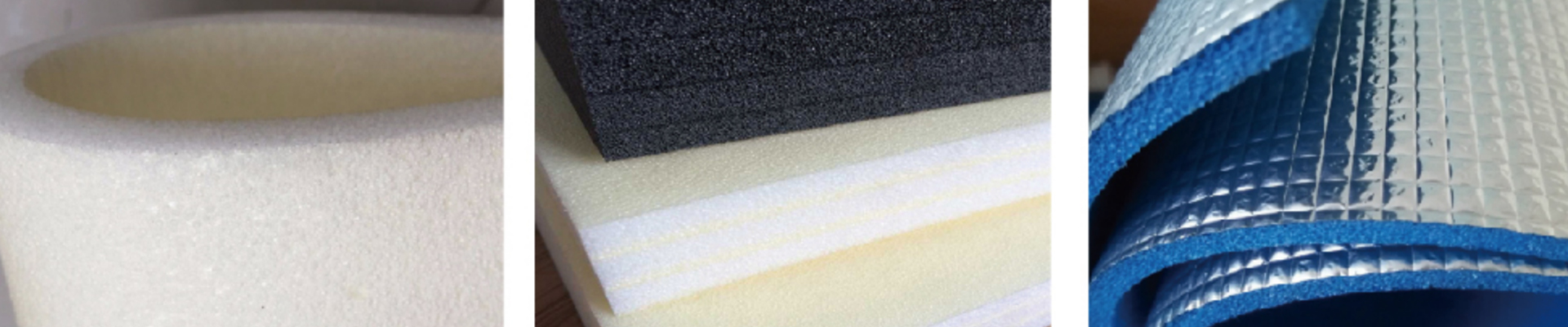
Understanding raw materials helps you make informed purchasing decisions. The industry primarily uses Polyvinyl Chloride (PVC), Ethylene-Vinyl Acetate (EVA), and Cross-linked Polyethylene (XPE).
When you contrast these materials, XPE consistently outperforms older technologies. PVC requires harmful plasticizers to become soft enough for infants. EVA foam often releases formamide over time as it degrades. Conversely, an xpe baby mat utilizes physical cross-linking. Manufacturers use intense heat to bond the polyethylene molecules together. This physical process completely eliminates the need for toxic chemical agents. Because the process skips plasticizers entirely, you avoid phthalates. This heat-based bonding also prevents formamide off-gassing.
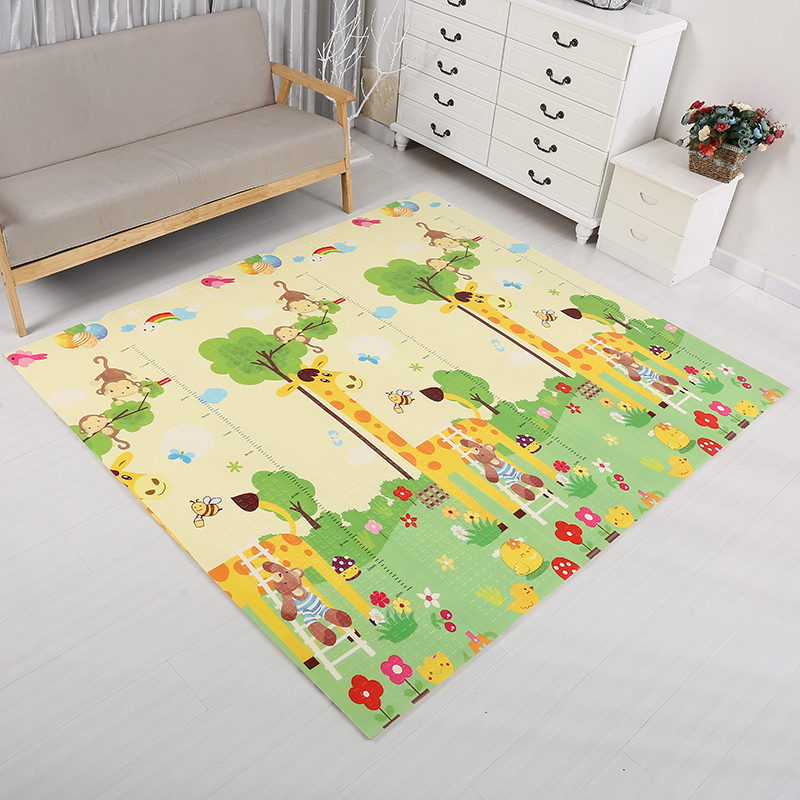
Physical structure heavily impacts daily safety and hygiene. Form factor dictates durability. For instance, an xpe rolling play mat provides a continuous, seamless surface. Traditional puzzle mats feature dozens of interlocking teeth. These tiny crevices trap dirt, milk spills, and pet dander. Worse, babies easily pull puzzle pieces apart. They chew on the loose edges. A rolling mat avoids this physical degradation. It removes the dirt-trapping creases found in poorly made folding mats.
We must address one critical caveat. XPE possesses inherently safer properties than PVC or EVA. However, raw material safety never bypasses the need for finished product certification. A factory could theoretically use clean XPE resin but contaminate it later. They might apply toxic inks for the surface patterns. Therefore, you must still demand CPC or EN71 certification for the final, assembled product.
Fraudulent claims run rampant online. We want to equip you with a skeptic's toolkit. Implementing these risk avoidance strategies protects your family from deceptive sellers.
First, always check the dates on the provided documents. A certification from five years ago holds zero value today. It does not cover current manufacturing batches. Factories frequently change suppliers to cut costs. A report dated 2018 cannot guarantee the safety of a mat produced in 2024. Demand recent documentation from the brand.
Second, strictly match the laboratory name. Unscrupulous sellers sometimes mock up their own certificates. Ensure an internationally accredited, CPSC-accepted laboratory conducted the testing. Look for globally recognized names. SGS, Intertek, and TÜV Rheinland represent the pinnacle of testing integrity. If you see an unknown lab name, proceed with extreme caution. You can often verify authentic reports through the laboratory's online portal using the certificate number.
Look for common loopholes regarding the "CE" mark. Many buyers assume a CE logo guarantees comprehensive testing. Unfortunately, manufacturers often self-certify the CE mark for certain product categories. They simply print the logo on the box. For toys and play mats, the CE mark means nothing alone. An actual EN71 laboratory report must back up the logo. Without the supporting lab data, the mark acts merely as decoration.
Watch out for these specific red flags:
Blurry or heavily pixelated certificate images on product pages.
Model numbers on the test report failing to match the product listing.
Customer service agents refusing to email a PDF copy of the compliance documents.
Descriptions leaning heavily on "natural" or "organic" without linking to chemical testing.
Navigating baby product safety requires ruthless diligence. Shortlisting safe options comes down to a simple, binary logic. Either the lab reports exist and remain verifiable, or they do not. Never compromise on this standard when outfitting your nursery.
We strongly advise buyers to prioritize mats made from intrinsically safe materials. Cross-linked polyethylene represents a massive upgrade over older foams. It delivers a closed-cell structure highly resistant to moisture and bacteria. However, always ensure the brand backs up their material choice. Up-to-date CPC or EN71 documentation remains non-negotiable.
Take immediate action before completing your purchase. Contact the manufacturer directly. Ask them for their latest testing reports. A trustworthy brand will gladly share their safety data. If they hesitate, take your business elsewhere.
A: A certified XPE mat requires minimal to no off-gassing. You might notice a faint "new product smell" right out of the box. This harmless odor dissipates rapidly within a few hours. It drastically differs from the toxic VOC off-gassing associated with uncertified PVC or cheap EVA foam. High-quality XPE undergoes physical cross-linking via heat, eliminating the harsh chemical residues that cause lingering, dangerous fumes.
A: A CPC guarantees the product meets federal minimums in the United States. It successfully screens for lead, heavy metals, and restricted phthalates. However, savvy parents should seek extra validation. Checking for formamide-specific testing or VOC certifications like Greenguard Gold adds a necessary layer of trust. These additional tests ensure the mat remains completely free of hidden respiratory irritants.
A: Mats peel when manufacturers use cheap, poorly laminated top-films to print patterns. This physical degradation is highly dangerous. Flaking plastic pieces create immediate choking hazards for infants. This directly violates mechanical safety standards. A high-quality mat utilizes advanced thermal pressing to fuse the layers. This prevents peeling and ensures the product can safely withstand a teething baby's bite force.
A: TPU and XPE sit at the very top of the safety hierarchy. They perfectly balance non-toxicity, durability, and shock absorption. TPU offers incredible scratch resistance and longevity. XPE provides a lightweight, utterly non-toxic alternative free from phthalates and formamide. Both materials avoid the severe chemical pitfalls of older options like PVC and EVA, provided they pass independent EN71 or CPC testing.