
Views: 0 Author: Site Editor Publish Time: 2026-05-30 Origin: Site


Stepping onto the training floor sets the foundation for every kick, pivot, and landing. Choosing the right martial arts flooring goes far beyond picking matching colors. For dojang owners and serious home practitioners, it is a critical safety decision.
The wrong dimensions easily complicate facility layouts. Worse, incorrect material density actively hinders proper biomechanics. This increases injury risks during intense training sessions. Taekwondo requires a precise balance. You need firm footing for pivot-based kicks alongside targeted shock absorption for heavy jumping landings. Unlike grappling disciplines, stand-up striking demands specialized surface tension.
This guide provides a deep technical breakdown of standard dimensions, optimal density metrics, and facility planning criteria. We cover everything from commercial dojang sizing to underlayment strategies. You will learn exactly how to configure your space for maximum safety, extend the lifespan of your flooring, and elevate your overall performance.
Commercial Standard: Professional taekwondo puzzle mats are almost universally 1x1 meter (approx. 3.28 x 3.28 feet) to minimize seams in large commercial spaces.
Home Standard: Residential puzzle mats typically measure 2x2 feet, optimizing for modular installation and easy closet storage.
Thickness & Density: The industry standard thickness is 20mm to 1 inch, paired with a Shore C hardness rating of 40–50 to prevent hazardous foot sinking during rotational movements.
Facility Requirements: An official competition area requires a minimum of 10x10 meters (including safety zones), dictating a specific volume of interlocking mats.
Purchasing the wrong tile size introduces hidden facility challenges. It leads to excessive cutting waste. It creates uneven floor plans. It also increases maintenance overhead due to too many physical seams. By understanding standard sizing, you can streamline your layout and reduce long-term upkeep.
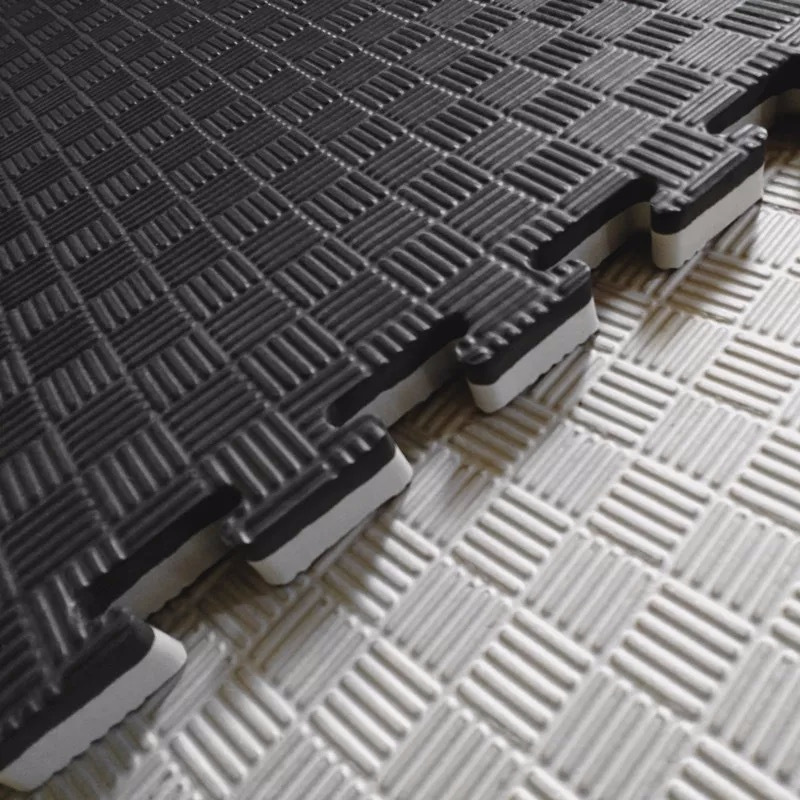
Commercial facilities typically rely on large-format interlocking tiles. These measure exactly 1 meter by 1 meter. They generally weigh around 6 pounds per tile. This robust size anchors the floor efficiently under heavy foot traffic.
Larger tiles mean fewer interlocking seams across a massive floor. This matters deeply for hygiene and durability. Fewer seams reduce the tiny gaps where dirt, sweat, and bacteria usually accumulate. Limiting these weak points extends the overall lifespan of the flooring system. It also allows floor cleaning machines and wide mops to glide smoothly without snagging on raised puzzle edges.
Residential setups demand a completely different approach. Home mats typically measure 2 feet by 2 feet. They are significantly lighter and easier to handle for a single person.
These compact dimensions are designed specifically for agility in tight spaces. You can maneuver them easily around support pillars, workbenches, or awkward garage corners. They allow for rapid DIY installation. You can break them down in minutes. Furthermore, their small footprint means you can stack them neatly inside standard bedroom closets. They offer high-performance flooring without permanently commandeering your living space.
Many beginners assume softer flooring provides better protection. In stand-up striking arts, this assumption is structurally dangerous. Proper biomechanics dictate a very specific material resistance.
Taekwondo relies heavily on the pivoting of the planted foot. Roundhouse kicks, spinning hooks, and tornado kicks all generate power from the ground up. Your base foot must rotate smoothly to release kinetic energy through the hips. If the floor grips your foot too tightly, the entire mechanical chain breaks down.
Biomechanical data and user feedback reveal a major hazard. Mats with too much "give" actively trap the supporting foot. If the mat is too soft, your foot sinks. It cannot pivot freely. When your upper body spins but your foot remains stuck, dangerous rotational torque transfers directly to the knee and ankle joints. This frequently leads to meniscus tears or severe sprains.
The golden standard for thickness ranges from 20mm (approx. 0.79 inches) to 1 inch (25.4mm). This is deliberately thinner than MMA or Judo mats. Grappling disciplines require 1.5 to 2 inches of foam to absorb heavy takedowns. Taekwondo prioritizes a fast, responsive surface over deep impact absorption.
Hardness matters just as much as thickness. The industry measures foam density using the Shore C scale.
Commercial Grade (Shore C 40–50): This rating provides the rigid, high-rebound surface necessary for fast footwork. It supports rapid barefoot pivoting without sinking.
Home Grade (Shore C 35): This rating is slightly more forgiving. It suits multi-purpose home environments well. However, it remains firm enough for safe striking and jumping.
You should always look for "thatched" or smooth surface textures. Traditional tatami grips feature aggressive ridges designed to help grapplers push off the floor. For barefoot strikers, tatami textures cause severe friction burns during rapid rotations. A thatched finish provides necessary slip resistance without tearing the skin.
Facilities hosting regional events must understand official ring dimensions. Aiming for official sparring compliance dictates your total material volume. Careful planning prevents you from coming up short during installation.
Official rules require a standardized central fighting zone. The core contest area must be exactly 8x8 meters. This equates to 64 square meters or roughly 689 square feet. Fighters begin every match at a standardized 2-meter separation. The space must safely accommodate explosive forward lunges and rapid retreating footwork.
A bare 8x8 meter square is incomplete. Safety regulations mandate an outer buffer zone. This protects competitors who are pushed or kicked out of bounds.
The total competition area footprint scales up significantly. With safety zones included, the area expands to 10x10 meters or even 12x12 meters. This requires 100 to 144 square meters of flooring (1076–1550 square feet) per ring.
Area Component | Metric Dimensions | Imperial Dimensions | Purpose |
|---|---|---|---|
Contest Area | 8m x 8m | 26.25ft x 26.25ft | Active scoring and sparring zone. |
Fighter Separation | 2m | 6.56ft | Standardized starting distance. |
Safety Buffer | 1m - 2m perimeter | 3.28ft - 6.56ft perimeter | Prevents hard falls off the mat. |
Total Footprint | 10m x 10m | 32.8ft x 32.8ft | Minimum requirement for regional hosting. |
Tournament-grade installations must feature a low-reflection surface. High-gloss finishes catch overhead arena lighting. This causes severe visual fatigue. Competitors struggle to track fast kicks. Judges miss critical electronic scoring impacts due to glare. A matte, low-reflection finish ensures visual comfort throughout long, multi-day tournaments.
Facility owners must weigh various solutions before making a final commitment. High-quality taekwondo puzzle mats are not the only option on the market. You must evaluate them against vinyl roll-out formats and traditional flat designs to understand what suits your space.
Feature | Interlocking Puzzle | Vinyl Roll-Out | Traditional Flat |
|---|---|---|---|
Installation Style | Modular teeth | Velcro seams | Wall-to-wall compression |
Material Base | Closed-cell EVA | Cross-linked PE foam | High-density PU foam |
Portability | High | Very High | Low |
Primary Drawback | Seam maintenance | Moisture slickness | Difficult relocation |
These modular squares dominate the striking world for good reason. They are highly accessible and incredibly adaptable. You can easily replace a single damaged tile without disturbing the rest of the room. Furthermore, they are typically dual-colored and reversible. This allows you to map out internal ring boundaries instantly without applying messy floor tape.
However, they do have drawbacks. Foam pores and intricate interlocking seams inevitably trap dirt over time. Under heavy commercial use, their physical lifecycle is somewhat shorter. You can expect an average replacement cycle of 2 to 3 years for high-traffic central tiles.
When evaluating different sports mats, roll-out variations offer distinct advantages. They provide virtually seamless coverage using heavy-duty Velcro connectors. The vinyl top layer is entirely non-absorbent. This makes mopping and sanitizing incredibly efficient. They are also highly portable, making them a favorite for traveling exhibition teams.
The downsides center around surface mechanics. The closed-cell foam base can feel quite stiff. More importantly, smooth vinyl surfaces become notoriously slippery when exposed to heavy sweat. This compromises footwork stability during grueling sparring sessions.
Traditional flat options deliver supreme structural integrity. They provide a snug, wall-to-wall fit that simply does not shift. Their extreme durability is unmatched. Many premium versions carry 10-year warranties.
The trade-off lies in their weight and permanence. They require significant logistical effort to install. They are incredibly heavy. Because of this, they are entirely unsuitable for multi-use community halls that need to clear the floor frequently for other events.
Successful installation requires planning beyond the top layer. Understanding longevity and sub-floor preparation ensures your environment performs safely over the long term.
While interlocking EVA foam offers a fantastic barrier to entry, you must plan for routine maintenance. Commercial facilities should anticipate replacing 20-30% of their high-traffic center tiles annually. The tiles around the perimeter usually remain pristine. By routinely rotating tiles from the edges to the center, you can significantly stretch the overall lifespan of the setup.
A very common implementation risk involves laying 20mm foam directly onto unyielding concrete. Concrete has zero mechanical give. Even with dense EVA foam on top, heavy jump-kick landings can still jar the knees and lower back over time.
There is a highly effective structural upgrade for garage setups and industrial warehouses. Lay a standard carpet padding layer directly between the raw concrete and the EVA foam.
This "sandwich" structure significantly improves overall impact distribution. The carpet pad absorbs the blunt trauma of the landing. Meanwhile, the dense EVA top layer maintains the necessary surface hardness required for rapid footwork. This hack protects the joints without sacrificing rotational speed.
Measure your total square footage accurately.
Factor in a 5% material overage to account for wall-cutting mistakes.
Always request physical material samples before committing to a massive freight order.
Test the Shore C density personally with barefoot pivoting drills.
Building a safe and professional training space requires precise attention to material details. We can distill this process down to a few critical actions.
Select dimensions based on your environment. Use 1x1m tiles for seamless commercial arenas. Choose 2x2ft tiles for modular, easy-to-store home gyms.
Prioritize material density over sheer thickness. A 20mm tile with a Shore C hardness of 45 will always outperform a 1.5-inch soft variation for stand-up striking.
Assess your facility's long-term lifecycle plan. Determine if the modular convenience of puzzle tiles aligns with your maintenance capabilities better than permanent flat systems.
Implement a proper sub-floor strategy. Do not ignore underlayment padding if you are installing over bare concrete.
A: Only over low-pile, high-density commercial carpet. Plush residential carpet causes the interlocking seams to separate under weight, creating dangerous tripping hazards. If you have thick residential carpet, you must place a rigid plywood subfloor down before installing the EVA foam on top.
A: Avoid harsh bleach. Use a damp mop with mild soap or specialized enzymatic cleaners designed for sports facilities. Ensure the room is thoroughly ventilated so the floor dries quickly. Prolonged moisture trapped deep in the interlocking seams can lead to severe mildew issues.
A: Shore C is the standard engineering scale used specifically for medium-density foams, like EVA flooring. Shore A is typically reserved for harder, denser solid rubbers. When evaluating any martial arts foam for striking purposes, always look for a Shore C rating between 40 and 50.