
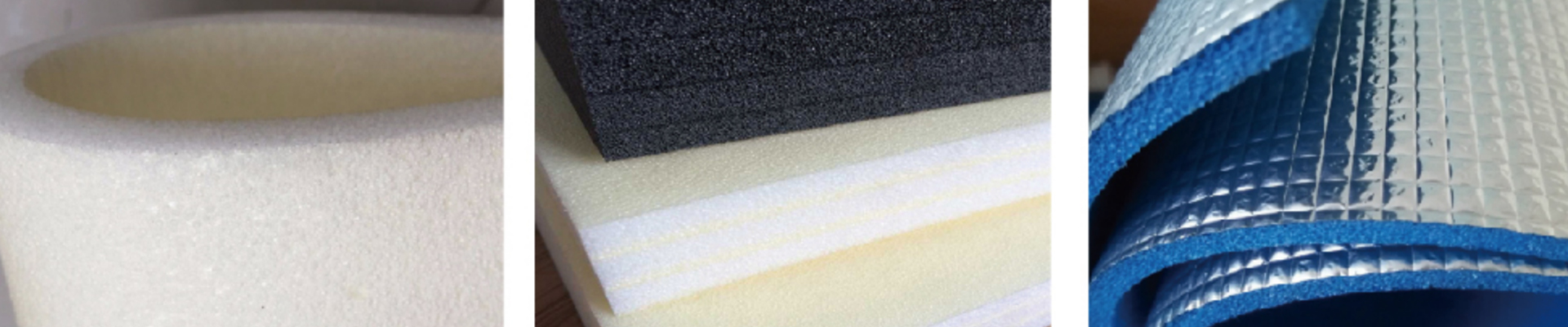
Views: 0 Author: Site Editor Publish Time: 2026-05-28 Origin: Site


Martial arts facility owners constantly face a difficult balancing act. They need flooring to deliver high-impact shock absorption while maintaining a firm surface. Practitioners require this barefoot-friendly stability for dynamic pivoting. Striking the wrong balance directly leads to joint injuries. Students experience ankle fatigue. Poor flooring simply ruins the training experience.
To solve this ongoing problem, the industry standard relies on specialized interlocking, closed-cell foam tiles. We refer to these as taekwondo puzzle mats. Manufacturers engineer these surfaces precisely for barefoot striking arts. They offer the exact stability martial artists demand.
This guide gives facility managers an evidence-based framework for evaluating these floor systems. You will learn how to select and install the correct setup. We base these recommendations on strict performance requirements and long-term durability. We explore material density, thickness variations, and daily operational protocols. Ultimately, you will gain the knowledge needed to build a safe, professional training environment.
Taekwondo puzzle mats are specialized, high-density EVA foam tiles, fundamentally different in firmness and texture from generic sports mats.
Selecting the right thickness (typically 20mm to 40mm) depends entirely on the ratio of stand-up striking to takedowns/throws in your curriculum.
Surface texture dictates traction and prevents skin burns during rapid barefoot pivoting and kicking.
Proper installation must account for the thermal expansion and contraction of EVA foam to prevent long-term seam warping.
General gym floors fail martial artists. They often feel too soft. Practitioners lose balance quickly on plush surfaces. Severe ankle fatigue sets in during intense sessions. Some facilities rely on general sports mats for their training areas. These generic options frequently feature smooth vinyl covers. Vinyl severely impedes barefoot pivots. Friction increases rapidly. Skin burns occur constantly. A dedicated martial arts floor requires highly specific engineering.
Modern taekwondo flooring relies entirely on closed-cell Ethylene-Vinyl Acetate (EVA) foam. This material science matters immensely. Open-cell foams absorb moisture. They act like giant sponges. Sweat and ambient humidity soak deep into the core. This creates massive hygiene risks. Closed-cell EVA foam blocks moisture penetration completely. Sweat stays on the surface. You can wipe it away instantly. Furthermore, this specific material provides exceptional structural memory. The foam rebounds quickly from repeated jumping impacts. It maintains its exact shape over thousands of training hours.
Puzzle edges differentiate these tiles from standard roll-out mats. Precision-cut teeth lock each tile together. This creates a seamless, monolithic floor space. High-velocity directional changes generate massive horizontal force. Practitioners plant their feet hard during spin kicks. Poorly designed floors slide apart under this tension. The tightly engineered puzzle mechanism prevents any dangerous shifting. The floor stays intact. You never have to worry about sudden gaps exposing the hard subfloor.
You must evaluate your curriculum before selecting a floor. Every martial arts discipline demands different physical properties. What works for grappling fails for striking.
Tile thickness dictates your fall protection level. Dojang owners often misunderstand this variable.
20mm to 25mm: These profiles serve pure stand-up striking perfectly. You use them for forms (poomsae) and traditional sparring. They provide maximum ankle stability. Home practitioners favor this thickness. It delivers a solid connection to the floor.
30mm to 40mm: Thicker tiles become necessary for diverse curriculums. Facilities incorporating takedowns require deep shock absorption. Sweeps and throws generate high impact forces. Hapkido or Judo integration demands 40mm profiles. This extra foam reduces concussion risks. It protects joints during heavy falls.
Density matters just as much as thickness. Manufacturers measure this using the Shore hardness scale. High density equals a firmer feel. Taekwondo requires a firm surface. Explosive jumping kicks require maximum energy return. If the floor feels too soft, the foot sinks. This sinkage absorbs the practitioner's kinetic energy. It also twists the ankle dangerously during rotation. Proper taekwondo puzzle mats feature higher Shore hardness ratings than typical gymnastics floors.
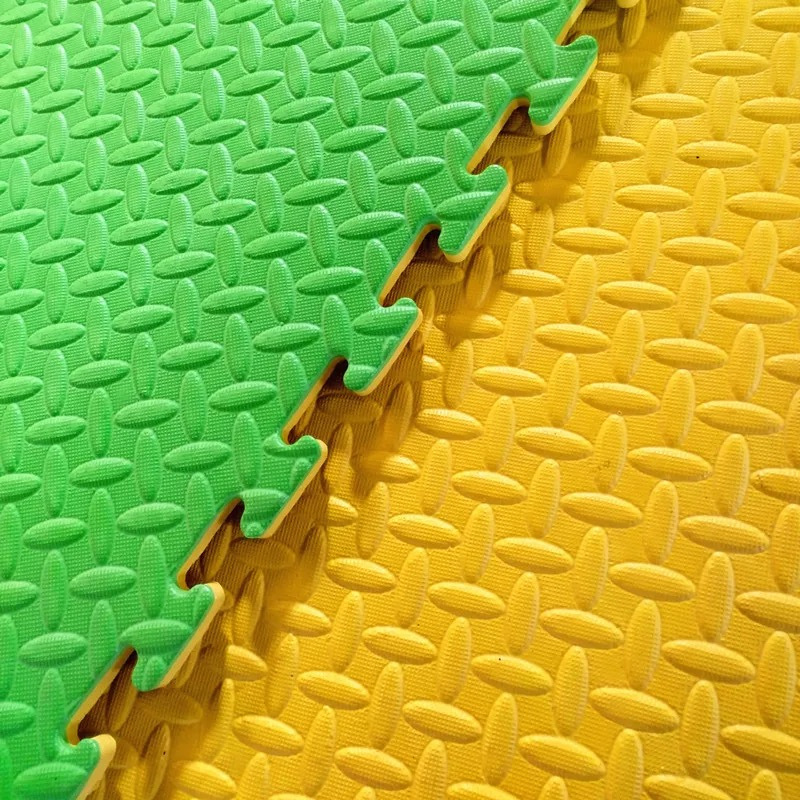
Texture dictates traction. Barefoot athletes rely on precise grip levels. Too much grip tears the skin on the sole. Too little grip causes slipping injuries. Manufacturers offer several standard finishes. Tatami textures mimic traditional woven straw. T-pattern finishes feature small, raised shapes. Cross-hatch designs provide subtle ridges. The T-pattern finish usually serves taekwondo best. It offers enough multidirectional slide for fast pivots. It prevents slip-and-fall injuries simultaneously. It drastically minimizes barefoot friction burns.
Most premium tiles feature dual colors. They offer red on one side and blue on the other. This reversibility provides massive utility. Instructors use color mapping to create visual training zones. You can build regulation sparring rings in minutes. You simply flip the perimeter tiles. Furthermore, reversing the tiles promotes uniform wear. You can extend the physical lifespan of the floor. You just rotate high-traffic zones regularly.
Mat Thickness | Primary Application | Fall Protection Level | Ideal User Base |
|---|---|---|---|
20mm | Pure striking, home use | Low | Forms practice, light drills |
25mm | Commercial striking | Moderate | Daily adult and youth classes |
30mm | Mixed curriculum | High | Light takedowns, kids' tumbling |
40mm | Multi-arts integration | Maximum | Heavy throws, Judo, Hapkido |
Buying the right tile solves only half the problem. Installation dictates the final performance. Many facility owners rush this step. They ignore basic material science. This negligence ruins premium products quickly.
Your base layer dictates the structural integrity of your floor. Concrete provides an excellent, rigid base. Hardwood floors work perfectly. However, carpet introduces severe risks. Never install interlocking tiles directly over plush carpet. The carpet compresses unevenly under body weight. This downward pressure forces the puzzle seams to pull apart. The teeth unlock. The floor separates dangerously. If you must build over carpet, you need a rigid sub-layer. Plywood sheeting creates a suitable barrier between the carpet and the foam.
Temperature fluctuations destroy improper installations. EVA foam responds directly to environmental changes. The material expands in high heat. It swells during heavy humidity. It contracts in freezing temperatures. This thermal reality causes the most common installation failure. You must leave a 1/2-inch expansion gap at all perimeter walls. If you push the tiles flush against the drywall, disaster strikes. As the room warms up, the foam expands. The tiles push against the wall. The pressure forces the center of the floor upward. Massive bubbling occurs. Tripping hazards form instantly. Always measure and maintain your expansion gaps.
Raw puzzle teeth look unprofessional. They also create entry hazards. Students trip over exposed interlocking edges. Manufacturers provide straight border strips. These transition edges slide directly onto the outer teeth. They create a clean, flat perimeter. You should apply these strips at all facility entry points. You must use them around doorways. Proper edge finishing prevents unnecessary accidents before class even begins.
Clean and level the hard subfloor thoroughly.
Map out your color zones before laying the first tile.
Leave a strict 1/2-inch gap along every structural wall.
Lock the teeth firmly without stretching the foam.
Apply straight border edges at all walkway transitions.
Facility operations require efficient protocols. Downtime hurts student retention. Complex cleaning routines exhaust your staff. Taekwondo puzzle mats simplify facility management significantly.
Continuous floors require massive effort to fix. A tear in a roll-out mat ruins the entire section. You face huge operational disruptions. Puzzle systems operate on strict modularity. A damaged section rarely affects the whole room. Someone drops a heavy weight on a tile. A sharp object punctures the surface. You simply pull up that single damaged tile. You drop a fresh tile into the empty slot. The repair takes thirty seconds. Your facility never misses a class. This modular approach keeps your training space pristine year after year.
Hygiene dictates your facility's reputation. Barefoot sports demand immaculate surfaces. You must establish evidence-based cleaning routines. Sweep the floor daily to remove abrasive dirt. Use a damp mop for deep cleaning. However, you must control your chemical choices. Always specify neutral pH cleaners. Harsh chemicals destroy EVA foam. Bleach strips the textured grip away quickly. Acidic solutions break down the closed-cell structure. The foam becomes brittle. Use mild soap or specialty mat cleaners exclusively. Never soak the floor. Excessive water seeps into the microscopic seams.
Durability timelines vary based on class volume. A heavy commercial dojang sees hundreds of students daily. High-traffic facilities typically replace their central tiles every three to five years. You can extend this timeline by rotating perimeter tiles into the center. Residential users experience much lower wear rates. A home training space easily maintains its integrity for over ten years. Proper climate control directly influences these lifespans.
Different environments demand different specifications. Avoid buying a product simply because it looks good. Match the engineering to your daily reality.
Prioritize a minimum thickness of 25mm for daily adult classes.
Demand high-density Shore hardness ratings for stable pivoting.
Select dual-color reversible tiles for instant curriculum zoning.
Verify all commercial fire-compliance ratings before installation.
Ensure the manufacturer provides a robust warranty against seam failure.
Focus exclusively on World Taekwondo (WT) approved textures.
Demand precise color matching for regulation tournament rings.
Prioritize fast assembly and disassembly features for weekend events.
Require tight interlocking tolerances to prevent shifting during elite matches.
Space-efficient 20mm tiles generally provide sufficient protection.
Emphasize ease of installation for single-person setup.
Verify odor-free, non-toxic certifications for enclosed residential rooms.
Choose neutral colors to match home aesthetics.
Selecting the optimal martial arts floor requires a precise decision matrix. You must balance your specific curriculum's impact level with your facility's environmental realities. Pure striking demands thin, firm surfaces. Mixed grappling requires deeper shock absorption. Never ignore the importance of thermal expansion gaps during installation. Establish strict, pH-neutral cleaning protocols immediately.
Your next step requires physical validation. Do not purchase an entire floor based on photographs alone. Order physical samples directly to your facility. Test the surface texture under actual barefoot conditions. Perform dynamic spin kicks to evaluate the density. Check the interlocking grip strength manually. Testing physical samples ensures your final choice delivers the exact safety and performance your students deserve.
A: You should never install interlocking tiles directly over high-pile carpet. The soft carpet compresses under your weight. This downward shift forces the puzzle seams to separate and unlock. If you must build over carpet, you need to install a rigid plywood subfloor first.
A: Sweep daily to remove abrasive dust. Mop the surface using a damp microfiber pad. Use only mild soap or neutral pH specialty mat cleaners. Warn your staff against soaking the floor or using bleach, as harsh chemicals degrade the foam and strip the grip.
A: Taekwondo tiles are typically thinner (20-25mm) and much firmer. They provide maximum ankle stability for standing pivots. BJJ mats are significantly thicker (40-50mm) and softer. Grapplers need deep shock absorption for heavy throws and extended groundwork.
A: Yes, EVA foam responds directly to temperature and humidity. The material expands in warm environments and contracts in the cold. You must leave a 1/2-inch perimeter gap around your walls during installation. This prevents the expanding tiles from bubbling upward.