
Views: 0 Author: Site Editor Publish Time: 2026-08-02 Origin: Site


Selecting the wrong thickness for an epe foam product compromises user safety, disrupts surface stability, and wastes budget. Expanded Polyethylene (EPE) is lightweight, cost-effective, and highly shock-absorbent. However, its structural performance relies heavily on precise thickness-to-density ratios. Buyers often assume thicker foam always means safer environments. This common misconception leads to poor purchasing decisions. We must move beyond generic "thicker is better" advice to protect users properly. This guide provides an evidence-based framework for specifying the exact thickness needed. You will learn how to evaluate impact ratings, specific use cases, and budget constraints. By understanding how physical travel distance and density work together, you can confidently source materials for homes, commercial play areas, or martial arts facilities. You will avoid common pitfalls regarding surface stability and logistics.
Thickness must be evaluated alongside density; a 20mm high-density mat often outperforms a 30mm low-density mat in impact absorption.
For an epe foam play mat, 15mm–20mm is the industry standard for baseline fall protection.
High-impact environments (martial arts, gymnastics) require 30mm+ to prevent "bottoming out" under localized pressure.
Factor in volumetric shipping costs and long-term compression set when shortlisting bulk B2B orders.
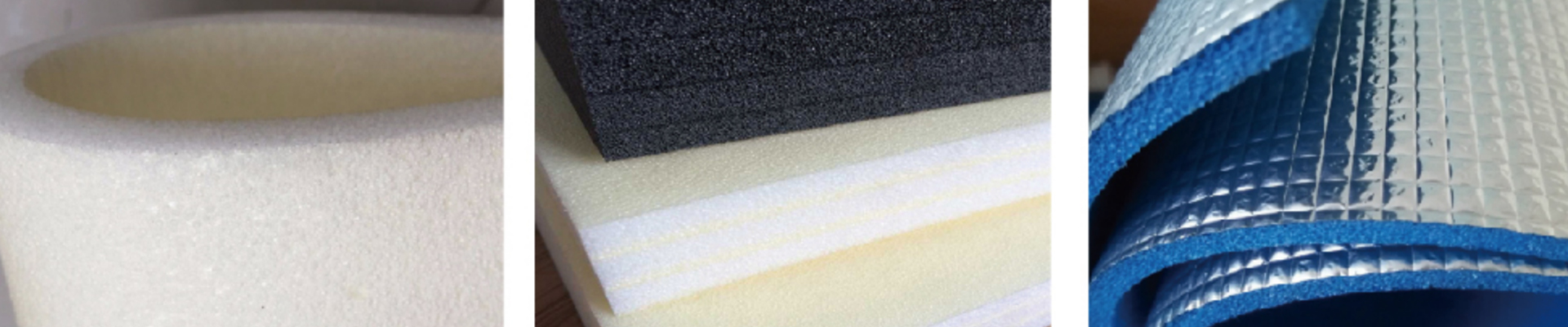
EPE foam features a highly efficient closed-cell structure. Countless tiny, sealed air pockets exist within the material. These pockets displace energy upon physical impact. Thickness provides the crucial physical travel distance required. This distance allows a falling body to decelerate safely over milliseconds. Without enough travel distance, energy dispersion fails completely.
Specifying material that is too thin causes severe risks. We call this critical failure "bottoming out." When the foam fully compresses, it offers zero remaining resistance. The cushion vanishes instantly under localized pressure. Kinetic energy transfers directly to the hard subfloor below. This failure risks critical joint injury to athletes. It also damages heavy equipment resting on the surface. You must calculate impact force to prevent this.
Conversely, over-specifying thickness creates entirely different problems. Excessively thick surfaces severely reduce structural stability. Toddlers and athletes lose proper footing on thick, yielding surfaces. High edges increase dangerous trip hazards across the floor. Furthermore, bulkier dimensions unnecessarily inflate freight and storage expenses. You end up paying heavily to transport and store extra air. We must find the optimal middle ground.
We categorize structural profiles to match specific activities accurately. You must align these profiles to your exact facility needs. Choosing the wrong category wastes money and risks safety.
Best for: Basic stretching exercises and temporary floor protection. They work exceptionally well for low-impact yoga sessions. Campers also place them under sleeping bags.
Limitations: They fail entirely during jump landings. They provide insufficient toddler fall protection. Do not use them for high-intensity training.
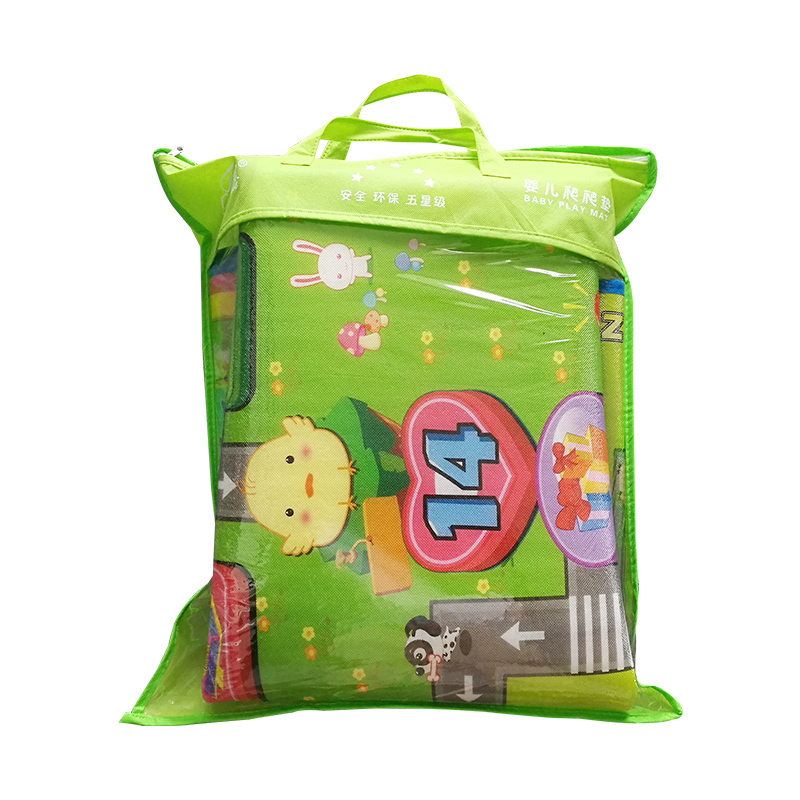
Best for: This range forms the standard epe foam play mat profile. We see it constantly in residential spaces and modern daycares. It handles light tumbling and bodyweight exercises effectively.
Performance Note: It offers the best balance of daily flexibility and cost. This thickness typically meets baseline CE and SGS safety compliance. Manufacturers use it widely for verified children's products.
Best for: Intense martial arts like BJJ and judo. Gymnastics facilities and high-frequency commercial play areas demand this robust range. Heavy throws require maximum deceleration travel distance.
Structural Requirement: Thick profiles require specific interlocking teeth designs. Manufacturers must engineer deep, wide seams. These seams ensure panels do not separate under lateral force. Standard small teeth will tear under heavy use.
Thickness remains entirely irrelevant unless you know the specific density. Manufacturers measure density in kilograms per cubic meter (kg/m³). High thickness cannot magically compensate for poor density. Under heavy static loads, low-density foam simply crushes flat. A 20mm high-density product easily absorbs more impact than a 30mm low-density product. We must specify both parameters together for safety.
You must evaluate thickness based on verifiable safety compliance. Standard global tests include EN 1177 and ASTM F1292. These frameworks calculate maximum safe fall distances objectively. They measure the Head Injury Criterion (HIC) during controlled drops. Do not accept vague "shock-absorbing" supplier claims. Always demand official third-party test reports. These reports must list the exact thickness tested.
Surface stability directly impacts user safety. Thicker EPE foam often feels spongy underfoot. Rapid pivot movements require a firm, stable base. Martial artists need solid footing to avoid severe ankle sprains. Early walkers on an epe foam mat need similar balance support. A thinner, higher-density profile proves much safer here. It outperforms a thick, low-density alternative by providing stable kinetic feedback.
EPE has a noticeably lower cross-linking degree than XPE. This chemical difference makes EPE slightly softer overall. It also makes it more prone to physical compression over time. To match the impact resistance of a 20mm XPE product, you must adjust. You may need to specify a 25mm thickness for EPE. Understanding this ratio helps you cross-shop materials effectively.
EVA offers a much denser, firmer feel. EPE provides superior cushioning for direct blunt impacts. However, EPE requires adequate thickness to prevent material tearing. It handles sheer stress differently compared to rigid EVA. If athletes perform twisting movements, EPE needs extra depth. This extra depth prevents the cellular structure from ripping apart.
Choose EPE when prioritizing lightweight shock absorption. It offers incredible cost-efficiency at higher thicknesses. Use the matrix below to guide your material decisions.
Material Type | Firmness Level | Recommended Thickness (Standard Use) | Primary Benefit |
|---|---|---|---|
EPE Foam | Soft to Medium | 20mm - 25mm | High cost-efficiency and excellent shock absorption. |
EVA Foam | Firm | 15mm - 20mm | High density and resistance to lateral sheer stress. |
XPE Foam | Medium to Firm | 15mm - 20mm | Strong structural memory and cross-linked durability. |
EPE foam naturally compresses over time. Heavy, static loads accelerate this process permanently. Cell walls fatigue and trap less air after repeated impacts. Calculate your minimum safety thickness carefully based on daily use. Always specify a buffer of 2-3mm. This extra padding accounts for long-term compression accurately. It ensures your safety rating remains valid years later.
Trustworthy suppliers readily disclose their manufacturing thickness variance. Common production tolerances range from ±1mm to ±2mm. Unchecked variances create severely uneven flooring surfaces. Uneven interlocking seams quickly become dangerous tripping hazards. Ask your supplier how they calibrate their cutting blades. Strict quality control prevents mismatched panel heights.
Carriers ship foam materials based on dimensional weight. Volumetric pricing models punish bulky cargo severely. Moving from a 20mm to a 40mm product doubles your shipping volume. This drastic volume increase severely impacts the final landed cost. Bulk B2B orders require strict logistical planning. You must optimize the thickness to balance safety and freight expenses.
You need a structured approach to evaluate vendors effectively. Sourcing industrial materials requires verifiable data and physical inspection. Follow these exact steps to secure reliable foam products.
Requesting Physical Samples: Always request a physical sample first. Test the exact thickness and density combination yourself. Drop heavy objects to check it rigorously for bottoming out risks. Evaluate the surface friction and texture for general safety.
Verifying Safety Certifications: Ask for specific SGS or RoHS compliance documents. These testing reports must tie directly to your requested thickness. Generic material certifications offer insufficient proof of safety. Ensure the certification dates are recent and valid.
Confirming Customization (OEM/ODM): Determine what modifications the supplier can realistically accommodate. You might need custom edge finishing or specific facility colorways. Anti-slip textures on thicker profiles are often necessary. Ensure these custom requests do not inflate the Minimum Order Quantity (MOQ) disproportionately.
Define your primary impact risk before specifying any structural dimensions.
Match your chosen thickness directly to a verified density rating for actual protection.
Account for natural long-term compression when calculating your safety buffers.
Factor in volumetric shipping logistics to prevent unexpected B2B freight expenses.
Evaluating foam materials requires physical testing and verifiable data. Start by requesting technical data sheets from your shortlisted vendors. Obtain physical samples of multiple density profiles. Test these samples under real-world pressure conditions before finalizing bulk orders. Proper specification protects your facility users and optimizes your procurement budget.
A: 15mm is the generally accepted baseline for mitigating minor falls on hard surfaces. Standard safety tests verify this dimension for residential environments. It provides sufficient travel distance to decelerate infant impacts safely. Always pair this thickness with a proper density rating to ensure the material does not bottom out.
A: No. EPE is primarily designed for shock absorption and human impact. Heavy static loads like treadmills or weight racks will permanently dent 10mm EPE. The cellular structure will crush and fail. You must use high-density vulcanized rubber instead for heavy machinery.
A: Thicker mats (30mm+) require deeper, wider interlocking teeth. Standard thin teeth will easily pull apart under directional stress. Robust interlocking designs prevent the seams from separating during intense physical activity. When purchasing thick profiles, always verify the structural integrity of the puzzle edges.