
Views: 0 Author: Site Editor Publish Time: 2026-07-29 Origin: Site


Parents across online forums frequently express mounting anxiety over the playboards they buy for their infants. Many complain about harsh chemical smells, rapid degradation, and hidden toxic off-gassing found in cheap foam products. These concerns highlight a severe gap in product safety awareness. The reality is product safety, durability, and compliance are entirely determined on the factory floor. The manufacturing process dictates whether a product remains a harmless play area or becomes a hidden hazard in the nursery. Understanding exactly how an xpe baby mat is produced equips buyers, distributors, and vigilant parents with vital evaluation criteria. You will learn how to identify true quality, dodge dangerous cheap alternatives, and confidently verify supplier manufacturing claims.
Physical Cross-Linking is Key: True XPE (Cross-linked Polyethylene) relies on physical or clean chemical foaming processes that eliminate toxic residues like formamide, unlike traditional EVA foam.
Multi-Layer Lamination: Premium mats utilize thermal bonding rather than toxic glues to fuse the XPE core with food-grade, printed CPP films.
Compliance is Measurable: Legitimate manufacturers validate their process through third-party testing for CPC, ASTM F963, and EN71 standards.
Structural Integrity: High-density cell structures dictate shock absorption and prevent the "bottoming out" effect common in cheaper EPE alternatives.
Buyers often struggle to differentiate between various foam materials. They frequently mix up EVA, EPE, and XPE foams. This confusion leads to poor procurement decisions based solely on price. It also exposes end-users to substandard materials. We must examine the core material science to understand true quality.
The solution lies in specialized polyethylene. XPE stands for Chemically Cross-linked Polyethylene. Another premium variant is IXPE, which means Irradiation Cross-linked Polyethylene. Both methods alter the fundamental structure of the polymer. They create a superior three-dimensional molecular bond. This bonding process radically improves the material capabilities.
Toxicity is the primary concern for any infant product. XPE cross-linking physically locks the molecular structure. This stable structure prevents any volatile organic compound (VOC) off-gassing. In contrast, EVA manufacturing often requires harsh chemical blowing agents. These agents frequently leave behind trace toxins like formamide. Formamide is a known hazard restricted in many global markets. XPE bypasses this danger entirely through cleaner foaming technologies.
Physical durability also separates these materials. XPE boasts a tightly woven closed-cell structure. This configuration provides superior waterproofing. Liquid spills cannot penetrate the foam matrix. It also delivers exceptional rebound elasticity. When a toddler falls, the foam absorbs the shock and immediately recovers its shape. EPE, often called pearl cotton, is highly brittle. EPE cells break down quickly under pressure, causing permanent flattening.
Foam Material Capability Overview
Material Type | Toxicity Risk | Durability & Rebound | Waterproofing |
|---|---|---|---|
XPE / IXPE | Very Low (Zero VOCs) | High (Excellent shock absorption) | 100% Waterproof |
EVA | High (Formamide risks) | Moderate (Prone to denting) | Water-resistant |
EPE | Low | Low (Brittle, flattens easily) | Poor (Cells can rupture) |
Best Practice: Always request material safety data sheets (MSDS) before approving a bulk foam purchase. You need absolute proof regarding the specific cross-linking agent used.
Production begins in the mixing facility. Technicians blend virgin PE resin carefully. They add specific colorants and safe foaming agents into the hopper. Using virgin resin is absolutely critical. Recycled plastics introduce unknown contaminants and compromise structural integrity.
Next comes the extrusion phase. Industrial extruders melt the compound at precise temperatures. The machine forces the molten plastic through a specialized die. This action forms a continuous master sheet. Operators must maintain strict temperature controls here. Any fluctuation creates uneven thickness in the master roll.
The unexpanded sheet moves to the foaming furnace. This furnace operates at extremely high temperatures. The heat triggers the cross-linking chemical reaction. The molecular chains bond together tightly.
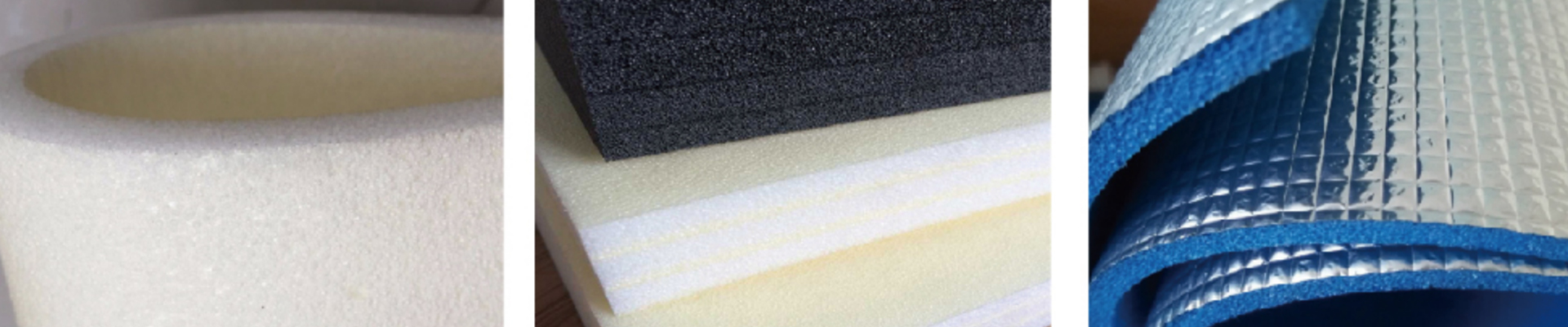
Simultaneously, the material undergoes massive expansion. The sheet expands 10 to 40 times its original volume. This rapid growth forms the signature closed-cell structure. The resulting foam is lightweight yet incredibly dense. It traps tiny air pockets evenly throughout the core. These pockets provide necessary impact absorption.
Visual appeal is crucial for consumer products. Factories use advanced reverse-printing technology on CPP (Cast Polypropylene) film. Reverse printing means the ink goes on the underside of the clear film. This ensures the food-grade ink never touches the baby’s skin.
The lamination phase follows printing. Premium facilities use glue-free thermal lamination. Hot rollers fuse the printed CPP film directly to the XPE core. Heat melts the surfaces just enough to bond them permanently. This completely eliminates toxic adhesives. Formaldehyde risks vanish when factories skip the glue.
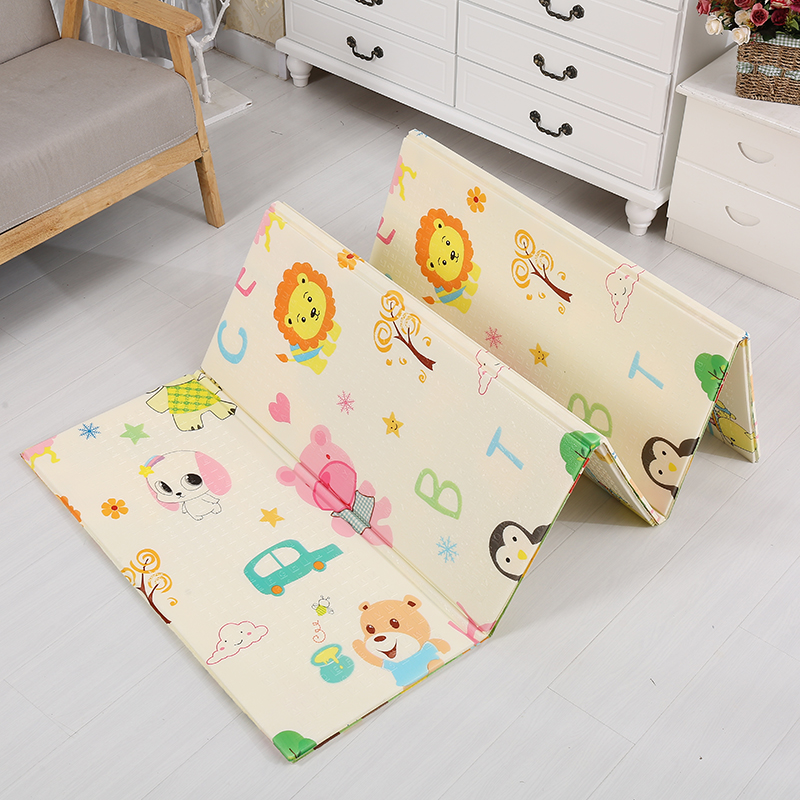
Bare film can be slippery. The embossed texture fixes this issue. Heavy steel rollers press raised patterns into the warm surface. Common designs include raised letters, numbers, or geometric grids. This texture adds essential anti-slip functionality.
Finally, automated machines perform precision cutting. They trim the continuous roll into standard consumer sizes. Workers then apply fabric edge-sealing. They stitch a durable border around the perimeter. This step seals the foam edges safely. It actively prevents baby chewing hazards.
Blend virgin PE resin and safe foaming agents.
Extrude the molten plastic into a continuous sheet.
Expand the material in a high-temperature foaming furnace.
Reverse-print the decorative design onto a safe CPP film.
Thermally laminate the film to the foam without glue.
Emboss the surface for anti-slip safety.
Cut to size and securely bind the edges.
Not all manufacturing facilities operate equally. Finding a reliable partner requires deep evaluation. You must distinguish a tier-1 facility from a low-end factory. A top-tier factory invests heavily in automated machinery. They maintain dust-free environments for printing and lamination. Low-end factories often rely on manual labor and outdated, dirty furnaces.
Certifications offer the fastest proof of competence. Demand absolute transparency regarding international standards. A legitimate factory readily provides CPSIA documentation for the US market. They supply ASTM F963 lab reports. European buyers should demand EN71 and REACH compliance certificates. Never accept outdated or blurred test reports.
In-house testing capabilities separate true manufacturers from simple assemblers. Ask suppliers about their daily laboratory routines. Look for manufacturers utilizing batch-testing protocols. They should test every single production run for heavy metals. They must check for phthalates continuously. Drop-test impact ratings ensure the foam density remains safe for falls.
Odor and curing protocols are heavily overlooked. Premium facilities understand post-foaming chemistry. They allow proper curing time after the furnace phase. This resting period lets residual heat and natural smells dissipate. They ensure the product is 100% odorless before sealing it in retail packaging. Cheap factories rush this step, trapping distinct chemical smells inside the plastic wrap.
Inspect the factory environment for clean-room lamination setups.
Verify third-party lab results directly with the testing agency.
Ask for their internal quality control checklist.
Request samples wrapped in retail packaging to test for trapped odors.
Cutting corners in manufacturing always impacts the final product. Buyers sourcing purely on price face severe implementation risks. These risks damage brand reputation quickly. They also trigger costly product recalls. You must recognize these hidden costs early.
Risk 1: Film Peeling (Choking Hazard)
Substandard thermal lamination causes massive safety issues. Some factories use inadequate heat or speed up the rollers. Others secretly use cheap chemical adhesives to save money. The top patterned layer inevitably peels off over time. A baby can easily rip this loose film and put it in their mouth. This creates a severe choking hazard.
Risk 2: False Density Claims
Resin is the most expensive raw material. Low-cost manufacturers manipulate the foaming process. They over-expand the foam to save raw material costs. The mat looks thick but feels suspiciously light. It compresses entirely under a baby's weight. The "bottoming out" effect means zero impact absorption when a child tumbles.
Risk 3: Mislabeling
Deceptive suppliers frequently sell cheaper EPE products branded as premium XPE. Buyers must learn how to spot the difference. You can identify mislabeled goods via touch and weight. EPE feels rougher and makes a crinkling sound when squeezed. XPE feels smooth, dense, and slightly rubbery. Visual inspection of the foam cells also helps. EPE cells are large and visible, while XPE cells are micro-sized and tightly packed.
Common Mistake: Approving a production sample without testing its tear resistance. Always try to pull the surface film off forcefully. If it separates easily, the lamination process failed.
Procurement teams must decide between different product formats. The two dominant styles are rolling and folding models. The structural differences in manufacturing dictate their unique advantages. Folding models require precise die-cutting. Factories must score deep grooves into the foam. They use specialized joint pressing techniques to create the hinges. This process slightly weakens the core structure at the seams.
In contrast, an xpe rolling play mat maintains a continuous, uninterrupted core. The factory skips the die-cutting phase entirely. This unified structure offers superior liquid resistance. There are no crevices for spilled milk or dirt to hide in. The uniform density provides a slightly safer tumbling surface.
Logistics and scalability play a huge role in your choice. You must compare shipping volumes carefully. Rolling formats require larger volumetric weight considerations. They ship as long cylinders. This shape leaves empty gaps inside a shipping container. Folding models optimize container space perfectly. They stack flat like bricks, maximizing freight efficiency.
Define your success criteria for bulk orders before contacting suppliers. Focus heavily on MOQ (Minimum Order Quantity) flexibility. Ask about their custom pattern ODM capabilities. Can they print your unique designs accurately? Finally, consider packaging durability during freight. Cylindrical packaging needs strong cardboard tubes to prevent crushing during transit.
Product safety starts long before it reaches the nursery. The reliability of any play surface depends entirely on the manufacturing facility. Strict adherence to clean extrusion protocols guarantees a safe foundation. High-heat physical cross-linking eliminates toxic chemical agents. Furthermore, glue-free lamination keeps formaldehyde far away from infants.
Look past aggressive marketing fluff and vibrant patterns. Demand technical spec sheets and verifiable density ratings from your suppliers. Insist on seeing independent lab testing certificates. By holding manufacturers to these rigorous standards, you ensure every product delivers genuine protection, durability, and peace of mind.
A: Yes, provided they are manufactured using physical or clean cross-linking and thermal lamination. This method eliminates the need for toxic glues or harsh chemical blowing agents. Always verify safety claims by requesting third-party testing reports from agencies like SGS or Intertek. Look specifically for tests confirming zero phthalates, zero BPA, and zero heavy metals.
A: EPE (Expanded Polyethylene) is non-cross-linked. This makes it cheaper and lighter, but highly prone to flattening, denting, and tearing over time. XPE is chemically cross-linked. This process creates a stable, closed-cell structure offering higher density, superior shock absorption, and a significantly longer lifespan.
A: The waterproof nature comes from two distinct sources. First, the inherent closed-cell structure of the XPE foam itself repels liquid and prevents moisture absorption. Second, factories thermally laminate a thin, clear CPP film over the surface. This film seals the printed design and provides an impenetrable, easy-to-wipe liquid barrier.
A: A strong chemical odor usually indicates the use of cheap EVA foam, formamide residues, or solvent-based adhesives applied during lamination. High-quality items manufactured using clean extrusion and thermal bonding should be virtually odorless right out of the packaging. Proper factory curing time also eliminates temporary manufacturing scents.