
Views: 0 Author: Site Editor Publish Time: 2026-08-04 Origin: Site


Shopping for baby gear often feels completely overwhelming for new parents. You face confusing material acronyms, deep anxieties about hidden toxins, and harsh daily cleaning realities. Every single choice feels like a high-stakes decision for your infant's well-being. Parents and facility managers desperately need reliable floor protection. You must carefully balance impact absorption, verified chemical safety, and household budgets. Unfortunately, aggressive marketing claims frequently blur the distinct lines between different foam types. This comprehensive guide provides a clear, evidence-oriented framework. We will help you confidently evaluate an epe foam play mat using verifiable safety standards instead of empty buzzwords. You will also learn exact thickness requirements for various developmental stages and structural differences between folding and puzzle designs.
Material Baseline: EPE (Expanded Polyethylene) foam is a highly affordable, lightweight, and inherently non-toxic alternative to PVC and EVA, though it is more prone to surface punctures.
Safety Verification: True safety is proven through third-party compliance (CPC, EN71, REACH), not just "non-toxic" marketing labels.
Thickness Mapping: Mat thickness should dictate use-case—0.4" to 0.6" supports basic tummy time, while 0.8" and above is required for fall attenuation during the early walking stages.
Format Selection: Folding mats offer superior hygiene and quick storage compared to interlocking puzzle pieces, which tend to trap debris in the seams.
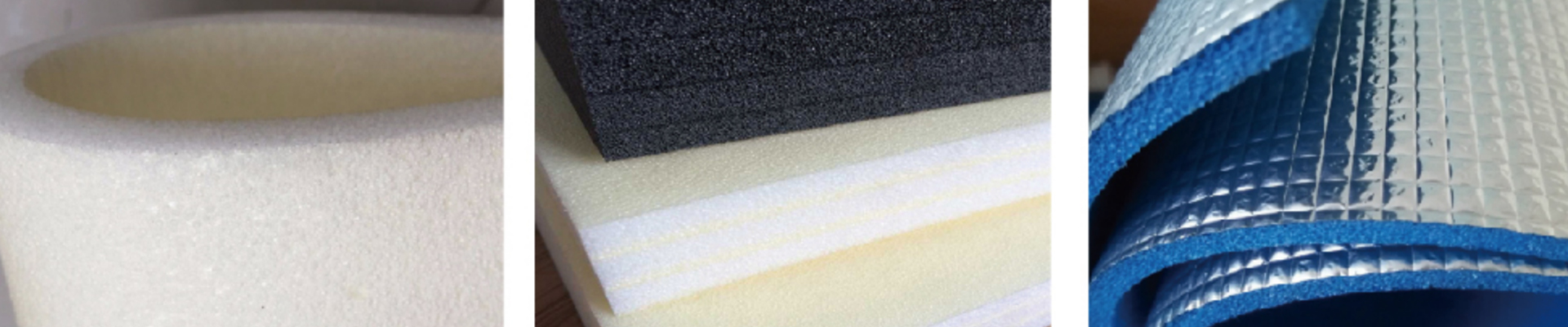
You must understand the materials beneath your child's feet. Manufacturers build modern play spaces using various synthetics. EPE stands for Expanded Polyethylene. It features a unique closed-cell structure. Millions of tiny, trapped air bubbles form this core. These bubbles provide excellent thermal insulation. They also deliver reliable shock-absorbing properties. epe foam remains incredibly lightweight. You can move large sheets easily around your home.
We must view marketing claims through a skeptic's lens. How does Expanded Polyethylene compare to competing materials?
Versus PVC (Polyvinyl Chloride): EPE completely eliminates the risk of phthalates. It contains no heavy metals. PVC often relies on dangerous plasticizers for flexibility. However, high-end PVC offers a heavy, memory-foam-like density. Polyethylene feels noticeably lighter and slightly firmer.
Versus EVA (Ethylene-Vinyl Acetate): Industry experts generally recognize EPE as the safer option. It arrives odor-free straight from the factory. Cheap EVA puzzle mats sometimes suffer from formamide off-gassing issues. Formamide creates a harsh chemical smell. Polyethylene avoids this toxic byproduct entirely.
Versus TPU (Thermoplastic Polyurethane): Premium TPU offers superior scratch resistance. It lasts significantly longer under heavy use. However, TPU commands a massive price premium. Polyethylene provides a much more cost-effective entry point. You can cover large playroom areas without breaking your budget.
Material Type | Primary Advantage | Main Drawback | Safety Profile |
|---|---|---|---|
Expanded Polyethylene (EPE) | Highly affordable and lightweight | Prone to surface punctures | Excellent (Inert, no off-gassing) |
Polyvinyl Chloride (PVC) | Heavy, durable, memory-foam feel | Expensive and heavy | Variable (Requires strict phthalate testing) |
Ethylene-Vinyl Acetate (EVA) | Soft texture, easy to mold | Can harbor odors | Moderate (Watch for formamide limits) |
Thermoplastic Polyurethane (TPU) | Extreme durability and scratch resistance | Highest market price | Excellent (Stable and non-toxic) |
Bottom Line for Buyers: Choose Expanded Polyethylene for lightweight portability. It guarantees strict chemical safety. It suits budget-friendly large-area coverage perfectly. You should avoid it if you expect intense puncture resistance. Cat claws and heavy furniture legs will dent or tear the surface.
Parents often fall victim to clever marketing terminology. The label "non-toxic" is entirely unregulated. Brands print this word freely on packaging. Unregulated marketing terms remain insufficient for infant safety. Babies explore the world through their mouths. They will lick, bite, and drool on their floor coverings. True safety requires rigorous laboratory testing.
You must look for hard certification criteria. Detail the specific compliance documentation before shortlisting an epe foam mat. Legitimate brands publish their testing results openly.
US Market Requirements: Look for a valid CPC (Children's Product Certificate). This document verifies compliance with ASTM F963. This strict standard governs toy safety. The CPC also proves CPSIA compliance. The CPSIA strictly limits dangerous lead and phthalate levels.
EU Market Requirements: European buyers must demand the CE marking. You should also verify EN71 certification. EN71 represents one of the most comprehensive chemical safety frameworks globally.
Chemical Specifics: Do not accept vague assurances. Demand explicit confirmation. The product must be completely free from BPA, Phthalates, Lead, Latex, and Formamide.
Common Mistake: Many parents ignore the surface coating reality. The foam core itself is chemically inert. However, manufacturers print colorful designs on the surface. They laminate these designs using a plant-based or PE film. The danger often hides in cheap printing inks. We advise buyers to ensure the film ink undergoes specific testing. Labs must verify colorfastness. They must confirm zero heavy metals exist in the pigment. A safe core means nothing if the surface laminate contains toxic dye.
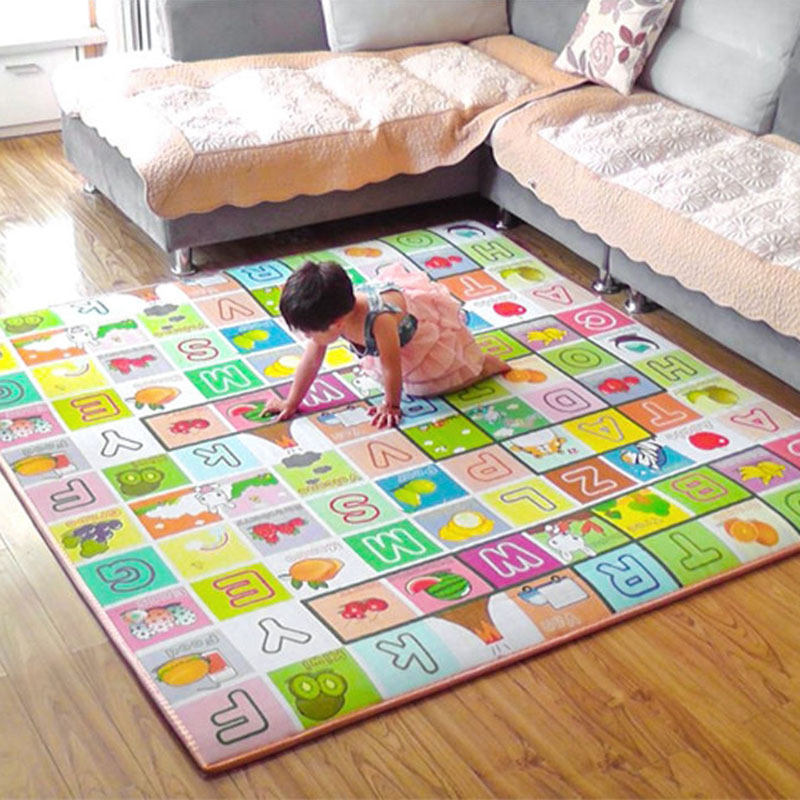
Floor coverings serve different purposes as your child grows. You must evaluate thickness specifically for fall attenuation. A newborn needs a different surface than a toddler learning to walk. Buying the wrong thickness wastes money and compromises safety.
Let us break down thickness profiles and their intended use cases:
Standard Profile (0.4” - 0.6”): This thinner category works perfectly for stationary play. It supports basic tummy time comfortably. It provides an excellent barrier over existing carpets. However, it remains insufficient for hard tile or hardwood fall protection. A toppling infant will feel the hard floor underneath.
Extra-Thick Profile (0.8” - 1.5”): You require this thickness for infants pulling to stand. It protects babies cruising along furniture. Early walking over hard surfaces demands this extra padding. It provides the necessary impact absorption for inevitable head strikes.
You must also understand the crucial difference between density and thickness. A thicker mat sounds better in theory. However, low-density foam creates hidden hazards. Low-density foam bottoms out immediately under pressure. High-density Expanded Polyethylene offers firm, stable support. This firmness prevents the dangerous "sinking" effect. Sinking frustrates early walkers and twists delicate ankles. A firm 0.8-inch mat protects better than a squishy 1.2-inch mat.
Developmental Stage | Recommended Thickness | Primary Floor Hazard |
|---|---|---|
Newborn / Tummy Time | 0.4" - 0.6" | Cold floors, dust, slight rolling bumps |
Sitting / Early Crawling | 0.6" - 0.8" | Backward falls from sitting position |
Pulling to Stand / Cruising | 0.8" - 1.2" | Vertical falls onto hard surfaces |
Independent Walking | 1.0" - 1.5" | Running slips and high-impact falls |
Best Practice for Measuring: Always calculate your footprint and coverage requirements carefully. Measure your intended play area. You must factor in a "safe buffer zone." Add at least two feet of padding around playpens or activity centers. Toddlers frequently trip exiting their play structures.
The physical design of your floor covering impacts daily hygiene significantly. The market primarily offers two formats: interlocking puzzles and reversible folding sheets. Each format presents distinct practical realities.
Interlocking Puzzle Mats:
Pros: You gain highly customizable sizing. You can easily fit irregular room shapes. You can buy extra packs to expand the footprint later.
Cons (Implementation Reality): Real-world usage exposes severe hygiene flaws. The interlocking seams trap everything. Spit-up, dust, crumbs, and pet hair settle deep into the cracks. Liquid spills create nightmares. You must disassemble multiple pieces to clean the hard floor underneath. Reassembling the puzzle daily becomes exhausting.
Reversible Folding Mats:
Pros: You receive a mostly seamless surface. This design blocks liquid penetration entirely. Wipe up spills in three seconds flat. The entire unit folds away instantly for shared living spaces.
Cons: Fixed dimensions limit your spatial flexibility. It might not fit perfectly into tight alcoves. The folding creases can slightly trap debris. However, you can wipe a straight crease much easier than complex puzzle seams.
Purchasing Advice: We strongly recommend seamless folding designs for high-traffic areas. Use them in spill-prone zones like living rooms or kitchens. Reserve interlocking puzzle formats for dedicated, dry playroom environments. Puzzles work best on carpeted rooms where spills happen rarely.
Setting realistic lifespan expectations saves you future frustration. Address the inherent physical limitations of Expanded Polyethylene upfront. It remains a budget-friendly, lightweight material. It will inevitably show compression dents over time. Heavy wooden toys or playpen legs leave permanent impressions. Furthermore, this material remains highly vulnerable to pet damage. A cat can shred the surface laminate quickly. Dog claws may puncture the outer film during active play.
Proper cleaning protocols extend the product's usable life. You must maintain the protective laminate layer carefully.
Do not use harsh bleach.
Never apply abrasive scrubbers or stiff brushes.
Harsh chemicals strip the protective laminate layer.
Use mild dish soap mixed into warm water.
Wipe the surface with a soft microfiber cloth.
Best Practice for Hygiene: Ensure the surface is completely dry before folding it up. Moisture trapped inside the folding creases creates a breeding ground for mold. Leave it flat in a well-ventilated room until zero moisture remains.
Finally, inspect warranty and return policies before purchasing. We advise checking the manufacturer's warranty specifically regarding laminate peeling. Edge curling represents another common failure point in budget production. Reputable brands offer at least a one-year warranty against manufacturing defects like edge separation.
Choosing the right floor protection requires moving past aggressive marketing claims. A qualified purchase means prioritizing certified chemical safety. Always demand hard documentation like a CPC or EN71 certificate. Select a thickness appropriate for your child's current mobility stage. Remember, early walkers need thicker, high-density support. Finally, choose a structural format aligning with your daily cleaning tolerance. Folding designs usually win for busy, spill-prone households.
Your next steps are clear and actionable. First, measure your available floor space and include a generous buffer zone. Second, assess your underlying floor hardness to determine your minimum thickness requirement. Finally, confidently request actual certification data from sellers before completing your checkout.
A: It remains chemically safe if properly certified. Tests prove it lacks toxic chemicals like lead or phthalates. However, serious physical bite hazards exist. If a baby bites hard enough, the material can tear. Loose pieces become choking hazards. Always choose mats featuring a high-density, durable laminate film to prevent easy tearing.
A: Yes, you can place it directly over existing rugs. A thinner 0.4" profile is usually sufficient here. The underlying carpet already provides excellent baseline shock absorption. However, you must monitor the edges carefully. Lightweight panels occasionally slide around on top of plush carpets, creating a minor tripping hazard.
A: Unbox the product immediately upon delivery. Lay it completely flat in a warm room. Leave it undisturbed for 24 to 48 hours. The ambient heat allows the closed-cell structure to expand naturally. The trapped air bubbles will settle, and the prominent folding creases will smooth out significantly over time.
A: High-quality Expanded Polyethylene should be virtually odorless right out of the packaging. It does not use formamide during manufacturing. Any slight, lingering manufacturing smell should dissipate fully within 24 hours in a well-ventilated space. Strong or persistent chemical odors are a major red flag indicating poor quality control.