
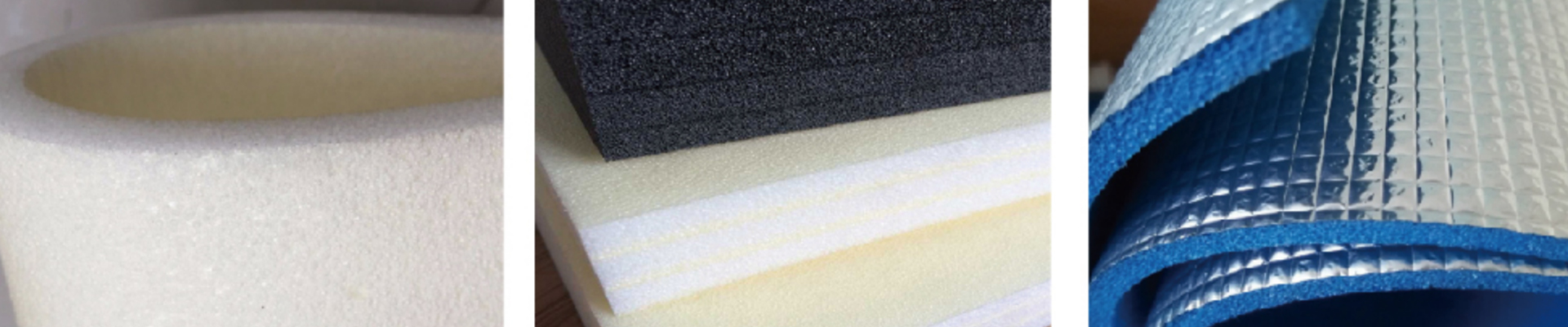
Views: 0 Author: Site Editor Publish Time: 2026-07-30 Origin: Site


Sourcing a custom baby mat demands more than just picking a cute design. You must balance aesthetic differentiation, strict safety compliance, and tight unit economics to succeed. Transitioning from off-the-shelf products to bespoke creations introduces complex, interconnected manufacturing variables. Brands often overlook hidden elements like printing plate fees, dimensional weight shipping penalties, and rigorous certification hurdles. Ignoring these factors can quickly ruin your profit margins or result in unsafe, non-compliant products. You need a clear, actionable understanding of production mechanics to avoid expensive mistakes. This guide breaks down the technical specifications, printing capabilities, and packaging configurations necessary to finalize your product strategy. We will explore structural choices, safety testing frameworks, and how to select a reliable manufacturing partner. Read on to master the production process and launch your product successfully.
Sizing & Structure: Thickness (1cm–2cm) and format (foldable vs. XPE rolling play mat) directly dictate freight costs and retail shelf footprints.
Print Safety: Safe custom printing relies on a reverse-printed PE film lamination process to ensure zero direct contact between the baby and the ink.
Packaging ROI: Selecting between non-woven carry bags, PE zip bags, and custom color boxes drastically alters the dimensional weight for e-commerce fulfillment.
Cost Drivers: Custom patterns require upfront plate fees, while custom foam textures or non-standard dimensions require expensive new molds.
Decision Focus: Aligning product dimensions with target age groups, safety requirements, and shipping constraints.
Manufacturers generally offer two primary structural formats for these products. Each format serves distinct consumer needs and logistical realities.
Foldable Mats: These utilize pre-pressed hinges across the foam core. They fold into compact blocks. This format proves highly space-efficient for e-commerce storage. However, hinges can easily trap dirt and debris if factory manufacturing tolerances are poor. You must verify the hinge durability during product testing.
XPE Rolling Play Mat: A seamless surface makes this format ideal for heavy-duty play. Parents appreciate the continuous, waterproof barrier. Structurally, an xpe rolling play mat requires higher dimensional shipping calculations. It cannot compress compactly. Yet, it consistently offers a premium, uninterrupted aesthetic for modern nursery designs.
Dimension selection directly impacts your upfront capital requirements. You should carefully consider factory standards before requesting bespoke sizes.
Common market sizes include 200x180cm and 200x150cm. Factories utilize existing molds to cut these standard sizes. Relying on established molds completely eliminates upfront tooling costs. It also significantly reduces Minimum Order Quantities (MOQs). We strongly advise new brands to start here.
Custom dimension requests tell a different story. They require entirely new mold fabrication. A new mold adds considerable lead time. You can expect a delay of 15 to 30 days before production even begins. It also demands a higher initial capital expenditure to machine the physical cutting tools.
Product thickness influences safety, comfort, and freight efficiency. Every millimeter alters your container packing density.
A baseline standard sits at 1.0cm. This thickness provides the lowest possible freight cost per unit. It offers adequate protection for general floor play. The premium tier ranges from 1.5cm to 2.0cm. Thicker mats provide significantly higher impact absorption. They better protect infants learning to walk. However, thicker mats reduce the total number of units per shipping container. This reduction directly increases your landed cost per item.
Thickness | Primary Use Case | Impact Absorption | Freight Efficiency |
|---|---|---|---|
1.0cm | General play, tummy time | Adequate | Excellent (High units per container) |
1.5cm | Crawling, early walking | High | Moderate |
2.0cm | Active toddlers, hard floors | Maximum | Low (Fewer units per container) |
Decision Focus: Achieving brand aesthetics without compromising CPC, ASTM, or EN71 safety certifications.
Safety dictates the printing method for all infant products. Factories rarely print directly onto the bare XPE foam surface. Bare foam struggles to hold ink securely under abrasive play.
Instead, manufacturers use a highly controlled reverse-printing method. They print patterns onto the underside of a clear, food-grade PE (Polyethylene) film. After printing, machinery thermally laminates this film directly to the XPE core. This engineering traps the ink permanently between the clear film and the soft foam.
This process guarantees zero toxic exposure. A baby only ever touches the unprinted, safe PE surface. The thermal bonding also prevents color fading from surface abrasion or daily cleaning.
You cannot compromise on chemical safety. Regulators heavily scrutinize baby products for harmful substances.
Specify Safe Inks: Require your manufacturing partners to use plant-based inks. Alternatively, they must use rigorously tested non-toxic, eco-friendly inks.
Demand Lab Reports: Never take a factory's word for it. Demand third-party laboratory test reports. Look for documents from SGS or Intertek.
Target Key Toxins: These reports must specifically verify the absence of heavy metals, BPA, and phthalates. The documentation must explicitly list the specific ink used on your production run.
Your design choices heavily dictate your setup fees. Printing relies on physical copper cylinders.
Continuous, repeating patterns remain far more cost-effective than large, localized murals. A repeating pattern requires a smaller printing cylinder. Every custom color in your specific design requires a distinct copper printing plate.
High-complexity designs increase costs rapidly. If you submit a CMYK photographic print, the factory requires at least four different plates. Each plate carries a setup fee. You must budget for these upfront costs when planning colorful, complex artwork.
Common Mistake: Submitting a design featuring a massive, non-repeating center mural. This forces the factory to use oversized printing cylinders, multiplying your plate costs exponentially.
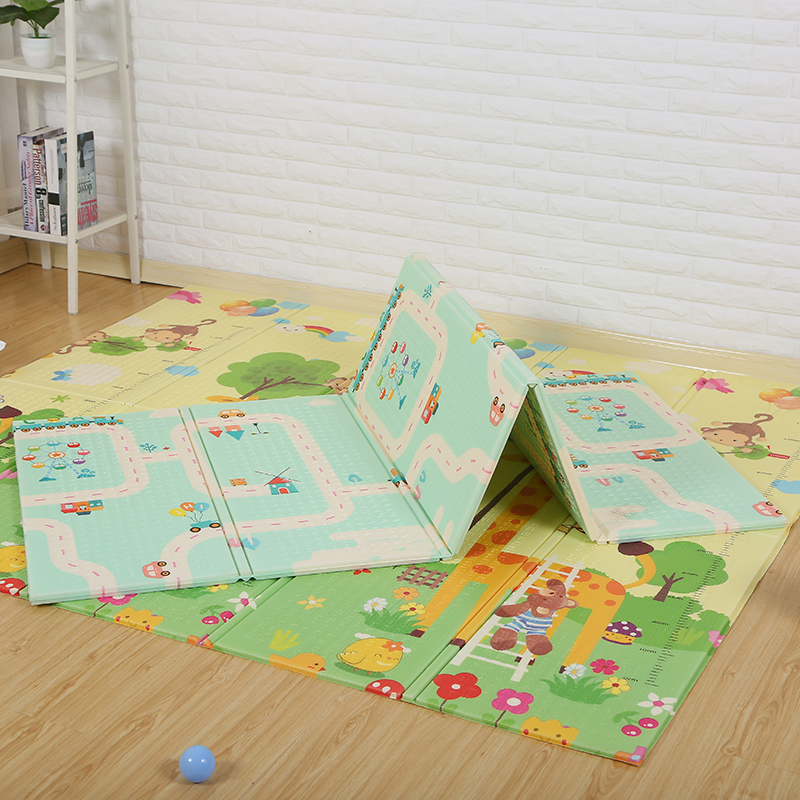
Decision Focus: Enhancing tactile feedback and safety through physical surface manipulation.
A flat plastic surface creates a dangerous slip hazard. Surface embossing solves this problem while improving structural integrity.
Embossing creates physical ridges on the PE film. These ridges increase friction, preventing slips during active play. The heat from the embossing roller also strengthens the lamination bond between the film and the foam core.
Standard factory embossing typically includes basic patterns. You will frequently see alphabets, numbers, or geometric grids. The industry calls the grid style an L-type texture. These standard patterns support early childhood tactile development. Because factories already own these texture rollers, utilizing them requires no extra mold fees.
Brands seeking maximum differentiation sometimes request bespoke surface textures. For example, you might want your company logo physically integrated into the foam pattern.
You must factor dedicated tooling costs into your budget for proprietary textures. Creating a custom embossing roller is an expensive, precise metallurgical process. Furthermore, custom textures require rigorous field testing. Overly deep grooves can easily harbor bacteria, dust, and spilled liquids. This frustrates end-users and leads to negative product reviews. We recommend keeping texture depths shallow to ensure easy wipe-down cleanability.
Best Practice: Always request a small prototype run of any custom texture. Smear baby food on it, let it dry, and test how easily a parent can wipe it clean.
Decision Focus: Selecting packaging that protects the product while optimizing dimensional weight (DIM) for retail or D2C shipping.
This packaging style dominates traditional retail environments. It features breathable fabric and a clear plastic viewing window.
Best for: Retail shelves and traditional wholesale distribution.
Pros: Consumers perceive a high product value. Parents often keep the bag, reusing it for long-term storage or travel. It looks excellent on a physical store shelf.
Cons: It performs poorly for direct e-commerce fulfillment. You cannot slap a shipping label on a fabric bag. It requires placement inside a secondary outer carton, which increases your overall fulfillment costs.
Direct-to-consumer (D2C) brands heavily favor sturdy cardboard packaging. A beautifully printed box elevates the unboxing experience.
Best for: Premium brands and E-commerce/D2C fulfillment.
Pros: A well-engineered box provides maximum protection against transit damage. It serves as its own shipping container, allowing you to ship a customized xpe baby mat straight to the buyer's door.
Cons: Cardboard increases the overall dimensional (DIM) weight. It also adds a high packaging cost per unit. You must conduct structural drop tests to ensure the box integrity survives rough courier handling.
Minimalist packaging serves a specific market segment. It eliminates excess weight and focuses purely on basic containment.
Best for: Budget brand tiers or inclusion within larger multi-product shipments.
Pros: It represents the absolute lowest packaging cost. It adds minimal weight to the final product.
Cons: A simple plastic bag offers a poor, uninspiring unboxing experience. Crucially, it provides zero protection against courier mishandling. Drops or punctures during transit will directly damage the foam product inside.
Decision Focus: Vetting manufacturers based on operational realities and verifiable quality control.
Manufacturing a foam mat requires precise temperature controls. The most common failure in custom production involves film delamination. Delamination occurs when the clear PE film peels away from the foam base.
You must actively test for this defect. Always request pre-production samples from your shortlisted suppliers. When they arrive, violently rub the edges. Fold the material back on itself repeatedly to stress the fold lines. Check the thermal bonding strength thoroughly. If you can easily peel the film with your fingernail, the manufacturing temperature was incorrect. Reject the batch immediately.
Minimum Order Quantities vary wildly based on your customization level. You need to align your inventory budget with machinery constraints.
Factories carry existing rolls of printed film for stock patterns. Therefore, stock patterns often have very low MOQs. You might secure an order for just 100 to 200 units. Custom prints change the math entirely. They demand higher MOQs, typically ranging from 500 to over 1,000 units. This happens because industrial film printing machinery requires a massive minimum run length of raw material just to thread the machine.
Regulatory compliance is non-negotiable. You hold legal liability for the safety of your imported items.
Do not accept generic factory certifications. Many suppliers will hand you a three-year-old certificate for a completely different product run. Ensure the manufacturer can provide fresh documentation. You need a CPC (Children's Product Certificate) and REACH compliance documents. These laboratory reports must specifically name your custom product formulation. They must also reference the exact ink types used in your production run. Clear traceability protects your brand from costly recalls.
Finalizing a custom XPE baby mat requires looking beyond the foam itself. By standardizing dimensions to existing molds, utilizing reverse-printed PE films for safety, and optimizing packaging for dimensional weight, brands can maintain healthy profit margins without compromising quality. The next step is to finalize your design file (specifying repeating patterns vs. fixed murals) and request an itemized quotation including printing plate fees, packaging costs, and standard EXW/FOB pricing from shortlisted, certified manufacturers.
A: No. Because the printing is applied to the underside of the waterproof PE film layer before lamination, the outer surface remains completely impermeable to liquids and easy to wipe clean.
A: Initial orders usually require 25 to 40 days. This accounts for printing plate creation (7-10 days), film printing, lamination, and final cutting/packaging. Repeat orders are generally faster (15-20 days).
A: The foam manufacturing and film printing machines require massive rolls of raw material to operate efficiently. Custom printing requires a minimum run of PE film, whereas custom packaging (like a printed box) can often be sourced in smaller batches from secondary packaging suppliers.
A: Vacuum sealing is generally not recommended for high-density XPE. While it reduces shipping volume, XPE has a slower memory recovery than standard polyurethane sponges, risking permanent creasing or damage to the laminated PE film.