
Views: 0 Author: Site Editor Publish Time: 2026-08-28 Origin: Site


Insufficient flooring introduces a severe operational risk in any dojo or home training facility. Poor flooring rapidly leads to joint fatigue, acute injuries, and poor athlete retention. Facility owners face a difficult dual challenge constantly. They must find flooring capable of absorbing heavy impact from aggressive throws and high-velocity falls. Simultaneously, this chosen flooring must maintain enough rigidity for pivoting and stability during striking and rapid footwork. An eva foam tatami mat solves this complex problem directly. It leverages closed-cell compression and highly specialized surface friction to protect athletes. However, its ultimate effectiveness depends entirely on one crucial decision. You must match the correct material density and physical thickness to your specific training modalities.
Energy Dispersion: Closed-cell EVA foam absorbs and disperses kinetic energy laterally, preventing force from rebounding directly into joints.
Texture Matters: The traditional "tatami" texture drastically reduces friction burns while providing the necessary grip for barefoot, high-velocity movements.
Spec to Sport: A Thick EVA Tatami Mat (40mm+) is mandatory for high-impact grappling/judo, while thinner, denser mats (20mm) are optimized for stand-up striking to prevent ankle rolling.
Installation Reality: Proper installation requires accounting for temperature expansion and subfloor hardness to ensure long-term structural integrity.
Facility owners often misjudge the crucial difference between simple softness and true shock absorption. Softness causes rapid muscle fatigue during intense, prolonged workouts. Shock absorption prevents severe acute injury during high-impact falls. Understanding this difference fundamentally changes how we design safe training environments. Soft, spongy floors allow the foot to sink deeply during movement. This sinking forces stabilizing muscles in the ankle to overwork constantly. Athletes quickly tire out, increasing their overall injury risk.
Ethylene-Vinyl Acetate acts as a highly dense, engineered material matrix. It contains millions of microscopic trapped gas bubbles inside its core. Upon physical impact, these tiny bubbles quickly compress together. They slow down human deceleration safely and comfortably. They disperse downward kinetic energy laterally across the floor before rebounding upward. The closed-cell structure blocks air from escaping upon heavy compression. Instead, the trapped air acts like thousands of microscopic airbags. They compress just enough to cradle the falling body safely. Then, they push back firmly to support the very next movement.
We see a clear inverse relationship between speed stability and deep cushioning. High-density materials yield significantly faster footwork for standing strikes. Lower-density materials offer deeper fall protection for heavy takedowns. Hard floors rebound kinetic force upward instantly. This dangerous force travels directly into ankles, knees, and hips. Proper material formulations find the exact middle ground safely. You need enough firmness to push off explosively. You also need enough yield to survive a heavy shoulder throw.
Table 1: Flooring Characteristic Comparisons
Flooring Trait | Biomechanical Effect | Primary Use Case | Injury Prevention Focus |
|---|---|---|---|
High Density / Firm | Promotes rapid energy return and fast pivots | Stand-up striking, Karate, Kickboxing | Prevents ankle rolling and knee torque |
Low Density / Soft | Maximizes deep compression upon heavy impact | Gymnastics, light rolling | Prevents bruising and blunt force trauma |
Balanced Closed-Cell | Disperses lateral force while supporting the arch | Judo, MMA, Multi-disciplinary gyms | Combines joint protection and fall safety |
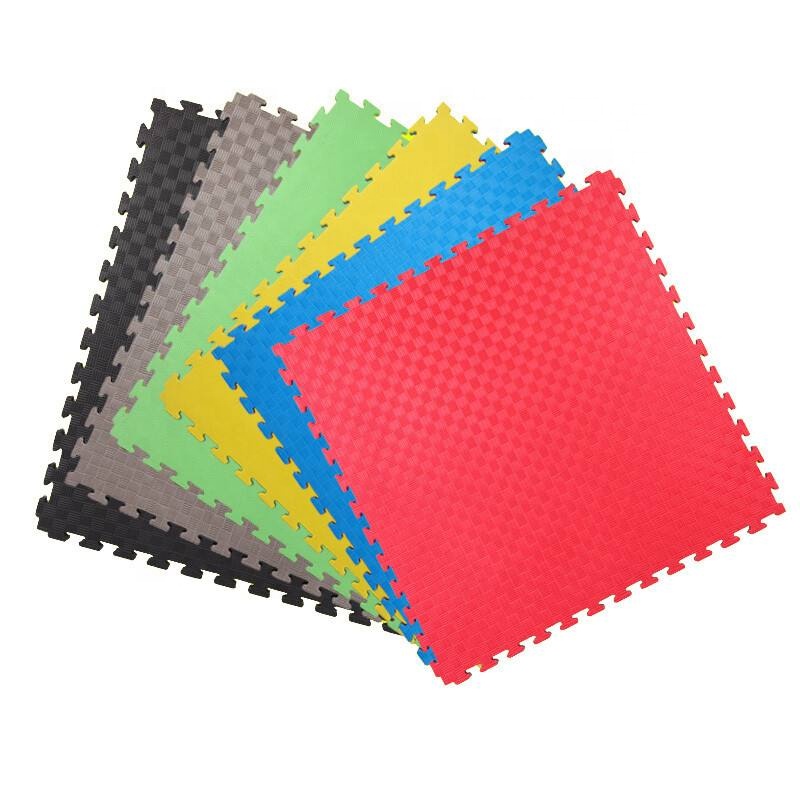
Break down the exact physical specifications required carefully. Primary use cases dictate these essential numbers. You cannot buy a universal floor covering expecting universal results. Different martial arts demand entirely different mechanical support systems. We categorize these solutions to help you make accurate facility decisions.
Striking arts require specific structural support for rapid movement. Karate, Taekwondo, and Kickboxing practitioners move incredibly fast on their feet. We recommend 20mm to 25mm thickness here. You require higher density to prevent foot sinking entirely. Sinking compromises pivot speed drastically during complex combinations. It also risks severe torque injuries to vulnerable knees and ankles. When practitioners throw high kicks, their planted foot must rotate freely. A rigid, thinner profile ensures this safe rotation happens instantly. Too much padding grips the foot, twisting the knee dangerously.
Grappling and throwing arts demand significantly deeper physical protection. Judo, BJJ, and MMA involve constant, aggressive takedowns. We highly recommend installing a Thick EVA Tatami Mat measuring 40mm to 50mm. You must provide deeper compression for blunt-force falls. Athletes repeatedly fall from hip or shoulder height daily. A robust 40mm profile absorbs these massive kinetic loads safely. The added depth prevents the athlete from feeling the hard subfloor beneath them. Without this thickness, collarbones and ribs take the full brunt of the concrete subfloor.
Hybrid zones require a careful, calculated structural compromise. Multi-disciplinary gyms usually select a 30mm profile. This moderate thickness balances stand-up stability and moderate takedown safety perfectly. It allows strikers to pivot without sticking. It simultaneously protects grapplers during controlled groundwork.
Audit your facility schedule to identify the most frequently practiced martial art.
Calculate the average height of falls typically experienced during your classes.
Assess your existing subfloor material to gauge baseline hardness.
Select a 20mm profile for pure striking or a 40mm+ profile for heavy grappling.
Request physical samples to test density under actual barefoot training conditions.
Analyze why the specific grooved finish remains an absolute industry standard. Smooth or diamond-plate textures fail miserably in martial arts environments. The specific directional grooves reduce severe skin friction efficiently. Groundwork and grappling generate immense friction against the floor constantly. Athletes drag their knees, elbows, and feet across the surface heavily. Standard rubber or bare vinyl causes painful skin burns immediately. The tatami finish creates tiny air pockets between the skin and the floor. These vital pockets minimize direct abrasive contact significantly.
Plantar stability matters deeply for dynamic barefoot training. The texture catches the barefoot securely without locking it rigidly in place. It provides the exact coefficient of friction needed for optimal performance. Athletes can execute safe, explosive directional changes confidently. Diamond-plate textures lock the toes too aggressively, causing sprains. Smooth textures become dangerously slippery when athletes inevitably sweat. The traditional grooved surface perfectly balances slip resistance and pivot freedom.
Furthermore, this specific texture mimics traditional woven Japanese straw physically. It honors the cultural heritage of martial arts accurately. Modern closed-cell polymers upgrade the durability of this ancient design. You get the aesthetic and functional benefits of tradition. You also gain the modern hygiene benefits of waterproof cellular materials. Sweat cannot penetrate the closed-cell surface easily. This keeps the training environment vastly more sanitary overall.
Acknowledge these physical limitations honestly before making any major purchase. Buyers must prepare for these specific installation realities proactively. Ethylene-Vinyl Acetate expands and contracts naturally during routine climate changes. Temperature fluctuations cause the material to shift slightly every day. Direct sunlight hitting the floor warms the foam rapidly. You must leave calculated expansion gaps at the surrounding walls during installation. This crucial empty space prevents the entire floor from buckling upward under pressure.
Subfloor preparation completely changes your effective impact safety rating. Installing directly over solid concrete feels vastly different than installing over sprung wood. Concrete requires thicker foam to achieve the same safety rating reliably. Furthermore, uneven subfloors cause major mechanical issues quickly. Dips and bumps in the concrete will cause interlocking teeth to separate. They pull apart gradually over time, creating dangerous tripping hazards. You must level your concrete subfloor before laying any interlocking tiles down.
Clearly understand your fundamental equipment limitations early on. Engineers design these products specifically for broad human impact. They cannot handle heavy point-loads safely under any circumstances. Dropping heavy kettlebells will permanently compress the foam cells. Heavy powerlifting racks will puncture the material entirely, ruining the tile. Keep heavy metal equipment far away from your dedicated barefoot zones. Use specialized high-density rubber stall mats for your weightlifting areas instead.
Compare interlocking tiles directly against other common flooring alternatives. Vinyl roll-out options or traditional polyurethane crash pads behave entirely differently. Interlocking systems offer a massive modular advantage for facility owners. You can replace damaged individual tiles quickly and easily. This inherent modularity lowers long-term replacement budgets significantly. Replacing a massive 10-foot section of a vinyl roll-out system costs far more money. A single puncture ruins an entire expensive vinyl roll.
Follow a logical framework for calculating your exact required square footage. Never buy the exact square footage of your room. You must factor in a necessary 5-10% overage for cutting and fitting. Edges require custom trimming to fit around pillars and corners perfectly. Establish a rigorous sample-testing protocol before finalizing any bulk facility purchase. Do not buy fifty tiles blind based on a website photo alone.
Measure your room dimensions twice to ensure absolute mathematical accuracy.
Multiply length by width to find your total required square footage.
Add a 10% overage margin to account for necessary wall-edge trimming.
Order single sample tiles from three different manufacturers for comparison.
Perform a barefoot pivot test on each sample to evaluate texture friction.
Perform a knee-drop test to evaluate genuine impact cushioning depth.
These modular solutions scale perfectly alongside your growing business. You can add more tiles easily if you expand your facility later. The interlocking teeth allow seamless integration of new sections into old sections. This flexibility provides unmatched financial peace of mind. It ensures your initial flooring investment remains highly adaptable over the years.
Impact cushioning isn't merely about buying the thickest material available. It represents a carefully calculated balance of engineering and biomechanics. You must weigh foam density, compression depth, and surface friction equally. Ignoring any of these three elements leads to suboptimal facility safety. Tailored options offer the highest safety-to-cost ratio available on the market today.
They remain the absolute ideal choice for martial arts, grappling, and barefoot functional training. Evaluate your primary training style carefully before buying anything. Are you prioritizing rapid striking mobility or heavy grappling safety? Let your daily curriculum dictate your final material specifications.
Request physical samples immediately to test the density in person. Drop your knees onto them, pivot your bare feet, and check the grip. Do this thoroughly before committing to a massive full-floor build-out. Making an informed decision now protects your athletes and your budget later.
A: We strongly advise against wearing standard athletic shoes. Running shoes feature aggressive rubber treads. These hard treads quickly tear the delicate tatami texture apart. This damage compromises the foam's integrity and creates slippery bald spots. We recommend training strictly barefoot. If necessary, use specialized smooth-soled wrestling shoes to protect the surface.
A: A 40mm+ thickness usually provides enough standalone cushioning on flat concrete. You generally do not need an additional foam underlayment for impact protection. However, if installing in a basement or garage, moisture issues arise. You must install a thin plastic vapor barrier first to prevent mold growth beneath the interlocking tiles.
A: Proper wall-to-wall fitting provides the best structural tension. Leave a small expansion gap, but frame the area tightly. For open-concept spaces lacking retaining walls, use double-sided acrylic floor tape around the outer perimeter. Additionally, purchasing high-quality tiles guarantees tight jigsaw tolerances, preventing the internal seams from pulling apart during heavy use.
A: Avoid harsh bleach or highly acidic chemicals entirely. These degrade the cellular structure rapidly. Use a non-corrosive, pH-neutral enzymatic cleaner mixed with warm water. Apply it using a soft-bristled deck brush. The soft bristles reach deep into the grooves without tearing the foam. Ensure the room has proper ventilation to dry the floor quickly, preventing mold.


