
Views: 0 Author: Site Editor Publish Time: 2025-11-03 Origin: Site


A thoughtfully designed play surface can make a measurable difference in early milestones and everyday safety. At Shandong Memizo New Material Technology Co.,Ltd (NOAH GROUP), our goal is to supply caregivers and childcare buyers with reliable solutions — starting with the EPE foam play mat as a safe, development-focused surface that supports tummy time, crawling, and independent play while staying easy to clean and maintain.
Infants learn a surprising amount from the floor. Raw floor types — hard wood, tile, or low-pile carpet — each present tradeoffs for infants practicing head control, rolling, and crawling. A surface that is too soft (deep pile) can make pushing up or pivoting harder; a surface that is too hard offers no shock absorption for falls. The ideal compromise is a surface that provides gentle cushioning while remaining stable under hands and knees. An EPE foam play mat gives predictable resistance and even support so babies can build the strength and balance necessary for motor milestones. Caregivers report more confident rolling-to-crawl transitions when infants practice on a surface that encourages weight-bearing through the arms and wrists without painful impact.
Pediatric and developmental guides consistently emphasize supervised floor play and tummy time during the first months as foundational for motor and visual development. Many experts recommend structured floor sessions on clean, non-slip surfaces that keep infants comfortable and visible to caregivers. Choosing a mat with a low chemical profile and stable surface aligns with those expert suggestions while also reducing barriers to daily supervised practice.
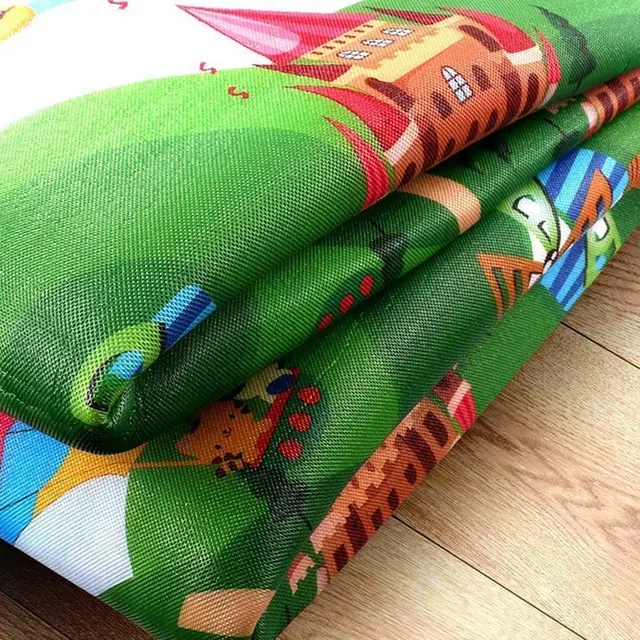
Sensory-rich environments encourage exploration. A well-designed mat balances visual interest with calm: high-contrast edges, gentle motifs, or subtle printed paths can attract reaching and crawling without overwhelming an infant’s developing sensory system. EPE mats can be printed with durable, non-toxic inks to include visual prompts — such as simple arrows, circles, or numbered stepping pads — that invite reaching, tracking, and later, gross-motor games.
Closed-cell expanded polyethylene (EPE) foam is inherently resilient: it compresses under impact and springs back to shape without absorbing liquids. That structure provides uniform tactile feedback that helps babies feel floor texture under their palms and knees — important for developing proprioception and coordination. In minor falls or stumbles, the EPE surface provides meaningful cushioning that reduces jarring forces, while the firm rebound avoids the “sinking” sensation that can hinder pushing behaviors.
Closed-cell foams do not absorb water, bodily fluids, or cleaning solutions, so spills remain on the surface and can be wiped away. Open-cell materials trap liquids and particulates and can become breeding grounds for microbes unless aggressively cleaned. For families concerned about allergies or daycare settings where surfaces are used by multiple children, a closed-cell EPE mat significantly reduces microbial retention and odor buildup over time.
Use a mild detergent and warm water for everyday cleaning; for disinfection, approved household disinfectants diluted per manufacturer instructions are safe for most EPE mats. Avoid high-alcohol, solvent-heavy cleaners or abrasive scrubbing that can degrade printed surfaces. After cleaning, allow the mat to air dry fully before rolling or storing. For high-traffic childcare settings, rotating mats and periodic deep-clean cycles help maintain both hygiene and surface integrity.
Puzzle tiles give modularity: children can rearrange pieces, and tiles can be expanded to accommodate growing play areas. They’re particularly useful in daycare rooms where layout flexibility matters. Folding mats provide a continuous surface that’s easier for rolling and obstacle courses. For developmental play, continuous surfaces help with longer crawling lanes and balance practice; for multi-use spaces, puzzle tiles offer versatility. Both formats can support independence: tiles encourage sorting and building, while folding mats create defined safe zones for self-directed play.
Printed pathways, target circles, and simple contrast shapes can be used as low-tech prompts for crawling games that practice direction changes and coordination. These small visual cues turn ordinary tummy time into guided practice — encouraging reaching, pivoting, and ultimately more complex locomotion patterns.
New foam products sometimes carry a mild manufacturing odor. High-quality EPE formulations minimize volatile emissions, and reputable manufacturers subject their materials to chemical testing and release documentation. Choose mats with clear test reports for volatile organic compounds (VOCs), phthalates, and heavy metals. Shandong Memizo (NOAH GROUP) produces EPE mats manufactured under controlled processes, and our product testing focuses on low emissions and non-toxic additive use.
With daily family use — play sessions, light spills, and occasional pet traffic — a well-made EPE mat can maintain function for several years. Lifespan depends on thickness and thickness density: thicker mats resist compression from repeated impact and heavy foot traffic. Routine cleaning, keeping sharp objects away, and rotating the mat in high-use areas extend life. For commercial daycare use, expect faster wear, so plan for a replacement cycle based on observed abrasion and hygiene needs.
Feature | EPE foam play mat | EVA foam mat | Carpet/rug |
Safety (fall cushioning) | Good — consistent rebound | Good — softer, but can compress | Poor — little impact absorption |
Longevity | High (closed-cell stability) | Medium (can compress) | Variable — stains, pile wear |
Cost | Competitive | Often similar | Varies widely |
Washability | Wipes clean, non-absorbent | Can absorb along seams | Hard to fully sanitize |
Portability | Lightweight, foldable/tile | Lightweight | Heavy |
Environmental concerns | Recyclable in some streams | Varies | Natural fibers possible |
New parents: Choose a 12–15mm folding EPE mat with a simple printed path for tummy time and early crawling practice. Daycare buyers: Opt for modular puzzle tiles, thicker density, and anti-slip backing for safety and ease of replacement. Gift buyers: Select a bright, washable folding mat with gentle prints and a carry handle for convenience.
Thickness options: 8mm, 12mm, 15mm, 20mm
Material: closed-cell expanded polyethylene (EPE) foam
Anti-slip backing and rounded safety edges
Non-toxic, low-VOCs; available test reports (VOCs, heavy metals, phthalates)
Surface finish: easy-wipe laminated or pure EPE for texture
Formats: foldable mat, puzzle tile, rollable play mat
Certifications & tests to show: SGS or equivalent chemical safety test reports, flammability standard results, and anti-slip test results
Custom printing options: visual prompts, logos, or child-friendly motifs
Packaging: reusable carry strap, recyclable carton
What is the recommended mat thickness for infants vs toddlers?
Is the mat waterproof and easy to disinfect?
What cleaning products are safe to use on this mat?
Does the mat contain PVC or phthalates?
Can I order custom dimensions or printed designs?
What is your warranty and typical lifespan under home use?
Are bulk discounts available for daycare or contract buyers?
Create short supervised floor sessions several times daily to build strength and curiosity. Use printed visual prompts as short-game cues — “crawl to the circle” — to turn repetitive practice into playful challenges. Rotate mat position to even out wear and keep visual stimulus fresh. For transport, fold or disassemble modular tiles and keep them dry before packing.
Wipe daily with mild detergent and water
Disinfect weekly in high-traffic settings using manufacturer-approved disinfectant
Air out new mats before first intensive use to reduce initial manufacturing odor
Inspect edges and seams monthly; replace tiles with visible damage
Spills and diaper leaks: wipe immediately, then disinfect per guidance. Heavy pet scratching: use thicker mat options and keep nails trimmed. Portable sleep surface? Not recommended; mats are for supervised play and not certified sleep surfaces.
An EPE foam play mat supports motor skill practice, tactile exploration, and safer play while simplifying hygiene for busy caregivers. Shandong Memizo New Material Technology Co.,Ltd (NOAH GROUP) offers a range of rigorously tested EPE surfaces designed for home and childcare use; to learn more about our specifications and request samples, contact us — we’ll help match the right EPE baby mat for your needs.

